
Do Creatine Gummies Degrade Faster Than Other Forms?
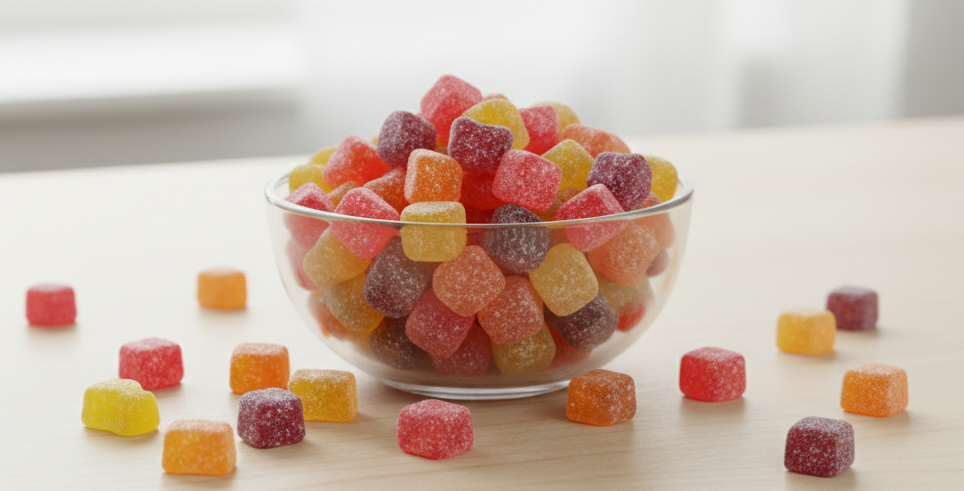
Creatine gummies taste good, so it is no surprise that they are an attractive option if you are thinking about supplementation. But there is a price to pay for that taste, and unfortunately that price is effectiveness.


The Chemistry of Stability
Creatine monohydrate is a small organic molecule that plays a major role in energy production within muscle tissue. Its strength as a supplement comes from its stability in solid form. In crystalline powder or tablet form, creatine monohydrate is remarkably resistant to breakdown.
Laboratory data show that pure creatine powder can remain chemically intact for years, even at elevated temperatures, with no significant degradation. This is why nearly every scientific study on creatine supplementation uses the powdered form.
When creatine dissolves in water, however, the story changes dramatically. The molecule begins to undergo an internal rearrangement that converts it into creatinine, an inactive compound that provides no performance benefits. This process accelerates at higher temperatures and lower pH levels.
When Water Meets Creatine
Creatine degradation in solution has been studied extensively. In controlled experiments, researchers found that creatine in effervescent formulations degraded by up to 90% within 45 days when stored at room temperature.
Even refrigeration only slowed this breakdown slightly. The reaction rate increases sharply as acidity rises, which explains why flavored or acidic beverages tend to destroy creatine quickly.
This instability has long been a challenge for supplement manufacturers. Despite decades of research, there are still no widely available ready-to-drink creatine beverages that retain full potency over time. The chemical nature of creatine simply makes it unsuitable for long-term storage in liquid environments.
Where Gummies Fit In
Gummies occupy a middle ground between solid powders and liquids. They are semi-solid matrices that contain some water and typically use acidic flavoring agents such as citric acid. This combination of moisture and acidity creates conditions under which creatine can degrade more quickly than in powders, though usually not as fast as in fully liquid solutions.
The exact degradation rate depends on several variables, including water activity, pH, temperature, and storage time. Even small differences in formulation can make a major difference in stability. For example, a gummy with slightly less water or a more neutral pH may retain its creatine longer, while a highly acidic gummy stored in a warm environment could lose potency rapidly.
Third-Party Testing
This theoretical concern has now been confirmed through independent laboratory analysis. In June 2025, the supplement testing organization SuppCo evaluated five creatine powders and six creatine gummies sold on Amazon. Each product was tested for its creatine content and for heavy metal contamination.
The results were striking. All five creatine powders contained the labeled amount of creatine and were free from contaminants. In contrast, four of the six gummy products contained virtually no detectable creatine. The active ingredient had either degraded or was never present in meaningful quantity.
Only two gummies (Create and Force Factor) contained the claimed amount of creatine. However, chemical analysis revealed that about 1% of each product consisted of creatinine, the degradation byproduct of creatine. This is 10x the creatinine permitted by ConsumerLab (0.1%) and supports the suspicion that creatine in gummies naturally breaks down over time, even under typical storage conditions.
How Stability Can Be Improved
There are scientific ways to slow this degradation, though they are not yet standard in most gummies. Researchers have developed technologies such as microencapsulation, in which creatine is surrounded by a protective protein or lipid layer that isolates it from moisture and acidity. Clinical studies have shown that this approach can maintain bioavailability and protect against early breakdown in aqueous solutions.
Another approach is pH buffering, which maintains a more alkaline environment around the creatine molecules. While such techniques could extend shelf stability and slow down conversion to creatinine, in principle, few manufacturers have adopted them, likely due to cost and production complexity.
Until these stabilization methods become common practice, creatine gummies will remain less effective than traditional forms.
Creatine Monohydrate Powder
Among all available options, creatine monohydrate powder continues to be the gold standard. It is the most extensively studied supplement in sports science, supported by hundreds of human trials showing benefits for strength, power, muscle growth, and recovery. It is also exceptionally safe and well tolerated.
Creatine monohydrate powder is extremely stable, inexpensive, and easily dosed. When stored in a cool, dry place, it maintains full potency for years. Tablets made from the same material share this stability, making them a convenient option for those who prefer not to mix powders.
Alternative forms such as creatine citrate, ethyl ester, hydrochloride, or nitrate blends have not demonstrated superior absorption, stability, or safety. They are often more expensive and, in some cases, less bioavailable. Research consistently confirms that none meaningfully outperform standard creatine monohydrate.
What to Look For
When choosing a creatine supplement, purity and transparency matter as much as chemistry. Independent analyses have found that only about 8% of creatine products on the market carry third-party certification, such as NSF Certified for Sport or Informed Choice. These certifications ensure that products are free from contaminants and contain exactly what the label claims.
Look for products that clearly list the amount of creatine monohydrate per serving, avoid proprietary blends that obscure dosages, and provide proof of third-party testing. These safeguards reduce the risk of underdosing or contamination with unwanted compounds like heavy metals.