
Does Compounded Semaglutide Work as Well as the FDA-Approved Versions?
In just a few years, semaglutide has become both a cultural sensation and a medical milestone. Originally designed to treat type 2 diabetes, it found a second, unexpected life as one of the most effective weight-loss drugs ever developed.
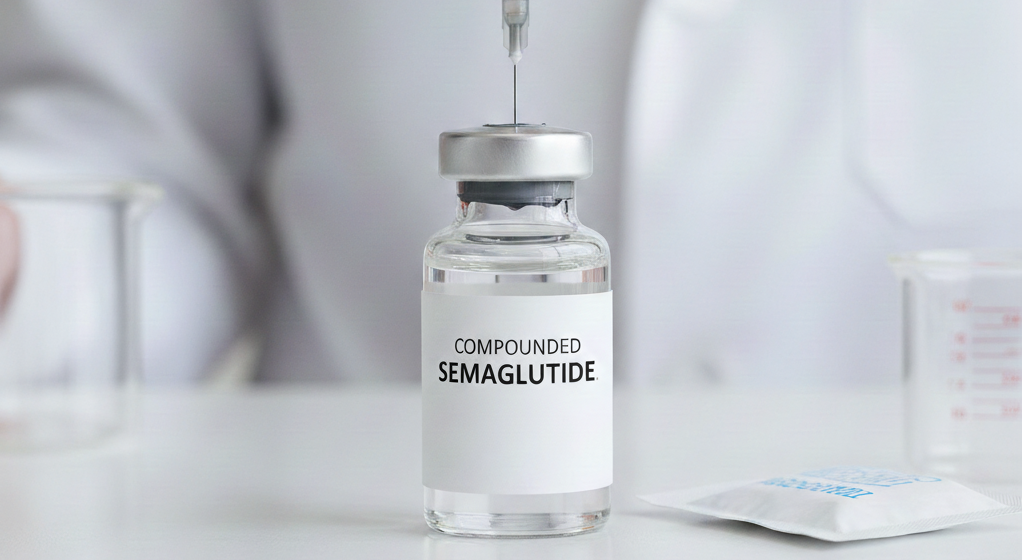
Yet, there are others turning to a cheaper alternative: compounded semaglutide. Compounding pharmacies across the country now offer their own versions of the drug, often blended with vitamin B12, and sold at a fraction of the cost. Advertisements promise results that sound identical to those of Ozempic or Wegovy.


The Original
To answer if compounded semaglutide actually works, it helps to understand what is already known about the real, pharmaceutical-grade version of semaglutide.
Across multiple large and meticulously designed clinical trials, the results have been remarkably consistent. Studies from the STEP, SUSTAIN, PIONEER, and SELECT programs have involved tens of thousands of people on several continents. Participants taking FDA-approved semaglutide lost as much as 15% of their body weight within twelve to eighteen months, a degree of weight loss once achievable only through bariatric surgery.
The benefits extend far beyond the number on the scale. In people with type 2 diabetes, semaglutide reliably lowers blood sugar and reduces inflammation. Long-term studies have also shown that it protects the heart and kidneys, improving survival in people with obesity, diabetes, and cardiovascular disease. These findings have been replicated across studies lasting two to four years, giving the drug one of the most comprehensive safety and efficacy profiles of any medication in its class.
In short, there is no longer any real debate about whether the FDA-approved versions work. They do, and they do so impressively.
The Copycat
Compounded semaglutide came onto the scene as a response to scarcity. During the first waves of public demand for Ozempic and Wegovy, shortages were widespread. Compounding pharmacies began advertising their ability to prepare semaglutide in-house to help fill the gap.
Compounding itself is not new or inherently unsafe. Pharmacists have long created custom medications when patients need specific doses or formulations that commercial manufacturers do not provide. However, compounding is not the same as manufacturing. The process is not subject to the same rigorous oversight, and compounded medications do not need to go through FDA approval before reaching patients.
This difference becomes especially important in the case of semaglutide. The approved drug uses a molecule known as semaglutide base. Some compounding pharmacies, however, use semaglutide sodium or semaglutide acetate, which are chemically distinct. These forms have never been tested in humans, and their stability, absorption, and safety are uncertain. A minor change in the chemical structure of a peptide can dramatically alter how it behaves in the body.
So while compounded products are sometimes described as “the same,” they are often not the same drug at all.
The Real World
Until recently, there was almost no clinical research on compounded semaglutide. That began to change with a small real-world study that evaluated a compounded version mixed with cyanocobalamin, or vitamin B12, in a commercial weight management program.
After three months, participants had lost an average of 4.1 kg, roughly 4.6% of their body weight. They also experienced reductions in fat mass and improvements in body composition. No major safety concerns were reported.
These results suggest that compounded semaglutide can be effective for short-term weight loss outside of a clinical trial. However, the effect was significantly smaller than what has been observed with FDA-approved versions, which can produce up to 15% weight loss in a year. The study also lasted only three months and included a relatively small number of participants. No conclusions can be drawn about long-term benefits or risks.
For now, this early evidence points to potential short-term benefit, but the long-term story remains untold.
Two Different Systems
The difference between an FDA-approved drug and a compounded product is not just a matter of branding. It reflects two entirely different systems of regulation, accountability, and quality control.
When a company seeks FDA approval for a new medication, it must submit data from preclinical research, human clinical trials, and laboratory testing. The manufacturing process must meet strict Good Manufacturing Practice (GMP) standards. Facilities are regularly inspected, and every batch of medicine must meet purity and potency requirements. Once approved, manufacturers are required to report any adverse events and monitor ongoing safety.
Compounded drugs operate outside that system. They are generally exempt from FDA approval, do not have to meet GMP standards, and are regulated primarily by state pharmacy boards. These boards vary in resources and enforcement, which leads to inconsistencies in oversight.
Because of this difference, compounded medications are not required to prove purity, potency, or stability before being dispensed. They may also lack standardized labeling, storage requirements, and dosage instructions. This increases the risk of contamination, incorrect dosing, or mislabeling. Historical safety incidents, such as contamination outbreaks from compounded sterile products, demonstrate the potential consequences when quality control breaks down.
For semaglutide specifically, the FDA has already warned that some compounded versions contain ingredients that are not the same as the approved active drug. The agency has urged prescribers and patients to use only FDA-approved products whenever possible.
Long-Term Evidence Matters
The major clinical trials of FDA-approved semaglutide are remarkable not only for their results but also for their duration. Studies lasting two to four years have shown sustained weight loss, improved cardiovascular outcomes, and kidney protection. Participants not only lost weight but also kept it off, with significant improvements in overall health.
For compounded semaglutide, such evidence simply does not exist. There are no long-term trials assessing its efficacy, safety, or consistency over time. There are no cardiovascular outcome studies, no kidney data, and no analyses of how different formulations behave in the body.
That means anyone taking compounded semaglutide is, in effect, participating in an unregulated experiment. There is no guarantee that the product will perform the same way, maintain its potency, or remain free from impurities.
What the Current Evidence Shows
When the available data are examined together, a clear pattern emerges.
- Short-term results: A small real-world study has shown that compounded semaglutide with vitamin B12 can lead to modest weight loss in a few months.
- Long-term results: All well-documented benefits come exclusively from studies of FDA-approved semaglutide.
- Quality and safety: Compounded semaglutide is not standardized and may vary in chemical form, potency, and purity depending on the pharmacy.
- Regulatory oversight: Compounded medications are not subject to the same federal manufacturing and testing requirements and are not required to demonstrate safety or efficacy before use.
Together, this means that while compounded semaglutide may sometimes work in the short term, its long-term effectiveness and safety remain unproven.
Why People Still Choose It
Despite the uncertainty, compounded semaglutide remains popular. Cost is a major factor. A monthly supply of Ozempic or Wegovy can cost more than one thousand dollars without insurance coverage, while compounded alternatives are often a few hundred dollars.
Accessibility is another reason. During product shortages or insurance denials, compounded semaglutide may feel like the only viable option. Some pharmacies promote their versions as customizable, offering smaller doses or vitamin blends to improve tolerance or reduce nausea.
These claims can sound appealing, especially when branded drugs are expensive or unavailable. However, without standardized testing, there is no assurance that compounded versions deliver consistent or predictable results.
Trust and Transparency
The rise of compounded semaglutide reveals a deeper issue in modern medicine: the tension between accessibility and assurance. When people cannot obtain the medications they need, they naturally seek alternatives. Yet the foundation of medical safety is consistency. Every vial of medicine must contain exactly what it claims to, produced under conditions that guarantee purity and potency.
FDA-approved semaglutide has earned global trust because its manufacturing and testing standards make that consistency possible. Compounded versions, while sometimes well-intentioned, do not offer the same guarantees. The difference is not about preference; it is about proof.