
Does Repatha Cause Weight Gain? The FOURIER Trial Evidence Across 27,000 Patients
If you are starting Repatha and you have heard horror stories about cholesterol medications and weight gain, the trial evidence is reassuring. Across 27,564 patients followed for a median of 2.2 years, Repatha (evolocumab) produced no excess in new-onset diabetes, no shift in glycemic markers, and no overall adverse-event difference compared to placebo. Weight gain is not among the adverse events the trial flagged; the only excess was mild injection-site reactions at 2.1% vs 1.6%.
This matters because the question of "does this cholesterol drug make me gain weight" gets asked about almost every lipid-lowering medication, even though the underlying mechanisms differ completely. Repatha sits in a different drug class than the medications that built that reputation, and its safety profile in trials reflects that difference.


Why the Question Keeps Coming Up
Statins, the most widely prescribed cholesterol drugs, have a complicated relationship with metabolic side effects. Reviews of statin toxicity describe muscle symptoms as the main reason patients discontinue, and catalog a broader set of statin-associated effects including increased diabetes risk and cognitive complaints. Many patients have heard about these or experienced them, and they reasonably wonder whether a newer cholesterol medication carries the same baggage.
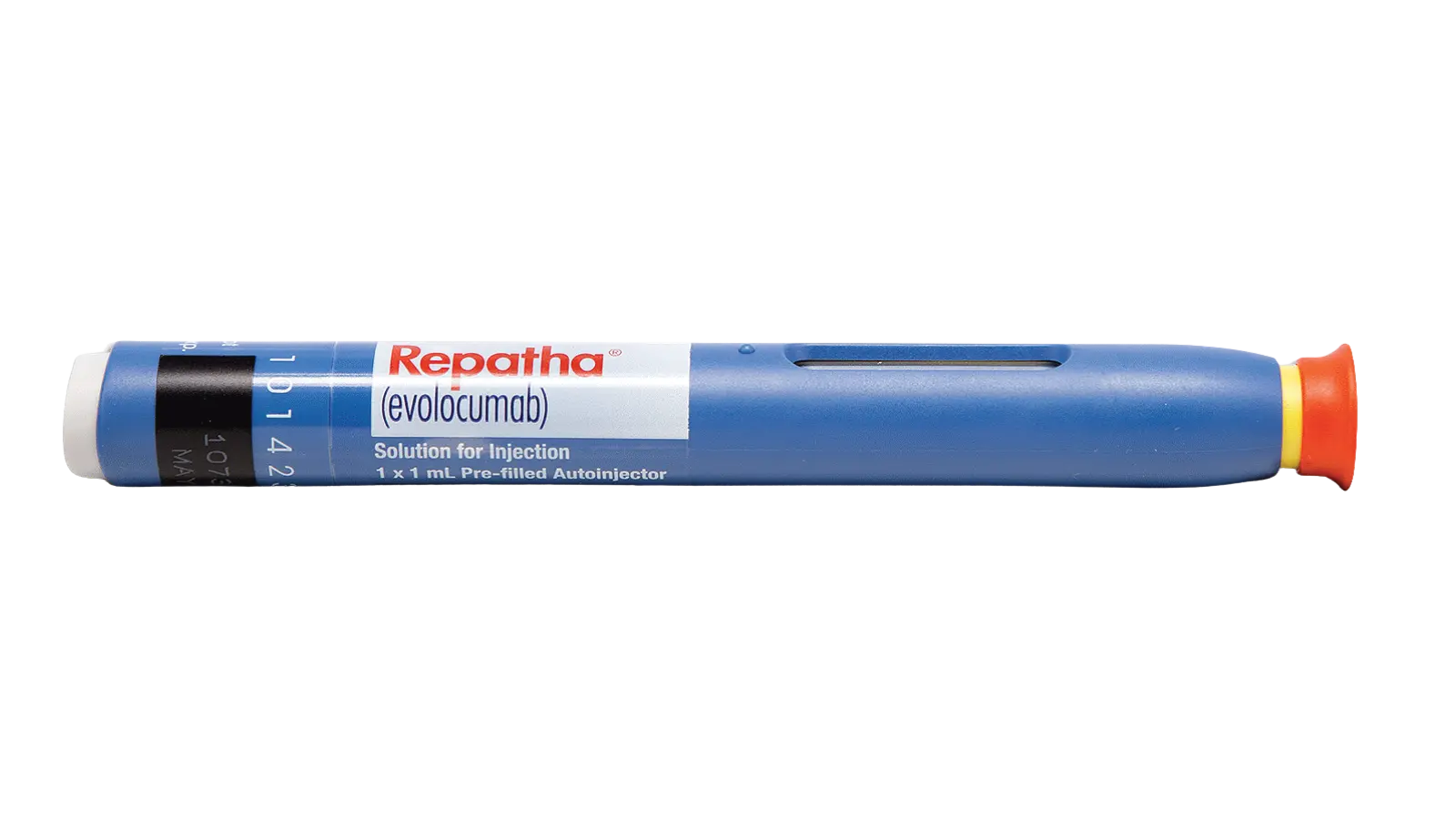
Repatha is not a statin. It is a monoclonal antibody that targets a single enzyme on liver cells (PCSK9), increasing the number of LDL receptors available to clear cholesterol from the blood. It does not touch the cholesterol synthesis pathway, it does not enter cells, and the narrow mechanism is exactly why its safety profile in trials looks so clean.
What the Trial Data Actually Shows
The FOURIER trial randomized 27,564 patients with established cardiovascular disease to Repatha or placebo, on top of statin therapy, and tracked them for a median of 2.2 years. It is the largest randomized comparison of any PCSK9 inhibitor against placebo.
Findings on metabolic and weight-adjacent endpoints:
- No significant difference in overall adverse events, including new-onset diabetes and neurocognitive events
- No worsening of HbA1c or fasting plasma glucose at any prespecified timepoint
- No increase in serious adverse events even at very low LDL-C concentrations (down to under 20 mg/dL)
A prespecified analysis of FOURIER focused specifically on diabetes risk found a hazard ratio of 1.05 (95% CI 0.94 to 1.17) for new-onset diabetes with Repatha vs placebo, with the same null result in patients who started the trial with prediabetes. HbA1c and fasting plasma glucose moved together in both groups across follow-up.
The pattern holds across the broader literature. A pooled analysis of 39 randomized trials covering 66,478 patients and 150,617 patient-years of exposure to either Repatha or alirocumab (a related PCSK9 inhibitor) found no increased risk of new-onset diabetes (P = 0.97), no liver enzyme elevations, no rhabdomyolysis, and no neurocognitive concerns. A separate meta-analysis of 35 trials covering 45,539 patients reached the same conclusion on diabetes risk.
What Drug-Induced Weight Gain Looks Like in Trials
To understand why these findings matter, it helps to see what real drug-induced weight gain looks like when you measure it.
A network meta-analysis of 25,952 patients across 18 antipsychotics produced clear, measurable weight effects. Clozapine raised body weight by 3.01 kg vs placebo (95% CI 1.78 to 4.24) over a median 6 weeks, and olanzapine raised BMI by 1.07 kg/m² vs placebo over the same window. These are signals you can see clearly in trials of a few thousand patients.
Repatha's trials cover an order of magnitude more patients followed for years, not weeks, and produce no comparable signal.
| Drug | Weight or BMI change vs placebo | Trial size | Source |
|---|---|---|---|
| Clozapine (antipsychotic) | +3.0 kg over 6 weeks | meta-analysis, 25,952 | |
| Olanzapine (antipsychotic) | +1.07 kg/m² BMI | meta-analysis, 25,952 | |
| Semaglutide (GLP-1 agonist) | -11.4% body weight | 5 RCTs, 4,421 | |
| Repatha (PCSK9 inhibitor) | Not reported as differing from placebo | RCT, 27,564 over 2.2 yr |
Prescribed by a licensed physician. Sent to your pharmacy.
The Long-Term Data Tell the Same Story
Short trials can miss slow-developing safety signals. Repatha now has long-term data that address this concern directly.
The OSLER-1 extension trial followed 1,255 patients on Repatha for up to 5 years. Yearly serious adverse event rates ranged from 6.9% to 7.9%, comparable to the 6.8% rate seen with standard care alone in the first year. No new safety patterns emerged with longer exposure.
The FOURIER-OLE open-label extension extended follow-up an additional 5 years beyond the parent trial, bringing the longest exposure to 8.4 years. Across that span, rates of serious adverse events, muscle-related events, new-onset diabetes, hemorrhagic stroke, and neurocognitive events did not exceed placebo rates from the parent study and did not increase over time. Patients who received Repatha earlier showed a 23% lower risk of cardiovascular death than those who started later (HR 0.77, 95% CI 0.60 to 0.99).
A separate FOURIER-OLE analysis looked at safety at very low LDL-C. Patients who reached LDL-C below 20 mg/dL showed no increased risk of serious adverse events, new cancer, hemorrhagic stroke, new-onset diabetes, neurocognitive events, or muscle-related events compared to those at higher levels. Lower LDL-C was monotonically associated with lower cardiovascular event rates and no offsetting safety cost.
What If You Are Gaining Weight on Repatha?
Trial averages do not capture every individual experience. If you started Repatha and noticed weight gain, the evidence suggests other factors are usually at play.
A few things worth ruling out:
- Other medications. Many drugs do cause weight gain, including antipsychotics, certain antidepressants, insulin, and some seizure medications. If you started something else around the same time, that is a more likely cause.
- Lifestyle and life events. People often start cardiovascular medications during stressful periods, after a heart attack or new diagnosis. Stress, sleep disruption, and reduced activity can drive weight changes that have nothing to do with the drug.
- Statin co-prescription. Most patients on Repatha also take a statin. The weight discussion around statins is more nuanced than for Repatha alone, and a recent statin change can confound the picture.
- Aging baseline. Adults often gain weight gradually with age, independent of any medication change. Over 1 to 2 years of treatment, this baseline drift is easy to attribute to a medication change.
If you are concerned about weight after starting Repatha, the productive next step is monitoring rather than discontinuation. Tracking weight, fasting glucose, HbA1c, and lipid response over a few months gives you and your clinician something concrete to work with. Instalab's Repatha program pairs the prescription with ongoing lab monitoring and physician follow-up so you can see whether your numbers actually shift on the drug or whether the pattern has another source.
What This Means If You Are Considering Repatha
The trial evidence on Repatha and weight is unusual in how clean it is. Across 27,564 patients in FOURIER, 1,255 patients followed for 5 years in OSLER-1, and 6,635 patients followed for an additional 5 years in FOURIER-OLE, weight gain has not surfaced as a signal worth flagging. Neither has new-onset diabetes, glucose dysregulation, muscle problems, neurocognitive concerns, or hemorrhagic stroke.
If your clinician has prescribed Repatha for elevated LDL or established cardiovascular disease, you are getting a drug whose safety profile is genuinely well characterized and reassuringly narrow. The main excess side effect across years of trial follow-up is a slightly higher rate of mild injection-site reactions. That is worth keeping in perspective when you read about cholesterol medications and metabolic side effects on the internet.