
Evolocumab: How a Twice-Monthly Injection Cuts LDL by 59% on Top of Statins
In FOURIER, the largest randomized trial of evolocumab, patients on statin therapy saw their median LDL cholesterol drop from 92 to 30 mg/dL, a 59% reduction beyond what their statin alone could achieve. That is roughly the same effect size as starting a statin from scratch, layered on top of the statin you're already taking.
That number is what makes evolocumab interesting. Statins lower LDL by inhibiting cholesterol production in the liver. Evolocumab works through a completely different mechanism, pulling down circulating LDL faster by giving your liver more receptors to grab it.


The PCSK9 Mechanism, in Plain Terms
Your liver clears LDL from the blood using LDL receptors (LDLRs) on the surface of liver cells. Each receptor binds an LDL particle, drags it inside, and then either gets recycled back to the cell surface or sent off to be destroyed.
PCSK9 is a protein your liver also makes that tags LDL receptors for destruction instead of recycling. The more PCSK9 you have, the fewer LDL receptors survive, and the higher your LDL ends up in the blood.
Evolocumab is a fully human monoclonal antibody that binds circulating PCSK9 and blocks it from interacting with the LDL receptor. Without PCSK9 doing its job, LDL receptors get recycled instead of degraded, your liver's surface fills up with more of them, and clearance of LDL from the blood goes up.
Across pooled trials, evolocumab and other PCSK9 antibodies lower LDL by 50 to 60% on top of statins.
What FOURIER Showed in 27,564 Patients
FOURIER was the first major outcomes trial designed to test whether evolocumab's LDL drop translated into fewer heart attacks and strokes. Researchers enrolled 27,564 patients with established atherosclerotic cardiovascular disease (mostly prior heart attack, stroke, or peripheral artery disease) whose LDL was at least 70 mg/dL despite statin therapy. Patients were randomized to evolocumab (140 mg every 2 weeks or 420 mg monthly) or matching placebo injections, on top of their existing statin.
Over a median 2.2 years of follow-up:
- The primary composite outcome (cardiovascular death, MI, stroke, hospitalization for unstable angina, or coronary revascularization) dropped from 11.3% on placebo to 9.8% on evolocumab, a 15% relative reduction (HR 0.85; 95% CI, 0.79 to 0.92).
- The key secondary endpoint (cardiovascular death, MI, or stroke) fell from 7.4% to 5.9%, a 20% relative reduction (HR 0.80; 95% CI, 0.73 to 0.88).
- Benefit was consistent across subgroups, including patients whose baseline LDL was already in the lowest quartile (median 74 mg/dL).
In absolute terms, that's about 1.5 fewer primary events per 100 patients over 2.2 years. Modest in absolute size, but the trial was relatively short, and most patients weren't at the highest end of cardiovascular risk.
Long-Term Follow-Up Out to 8 Years
The picture changes when the timeline extends. FOURIER-OLE was the open-label extension that followed 6,635 of the original FOURIER patients for a median of 5 additional years, with maximum exposure to evolocumab reaching 8.4 years.
In the long-term data:
- Median LDL stayed at 30 mg/dL, with 63.2% of patients achieving LDL under 40 mg/dL.
- Patients originally randomized to evolocumab had a 15% lower long-term risk of the primary composite endpoint compared with those who received placebo first (HR 0.85; 95% CI, 0.75 to 0.96).
- The 3-point MACE endpoint (CV death, MI, or stroke) showed a 20% lower long-term risk (HR 0.80; 95% CI, 0.68 to 0.93).
- Cardiovascular death was 23% lower in the early-evolocumab group (HR 0.77; 95% CI, 0.60 to 0.99; P=0.04).
The implication: getting LDL very low early matters more than getting it low later. Patients who started evolocumab at the trial's beginning ended up with measurably lower mortality than those who got the same drug a few years later.
Prescribed by a licensed physician. Sent to your pharmacy.
Trial Snapshot
| Trial | LDL change | Follow-up | Major outcome | Source |
|---|---|---|---|---|
| FOURIER (n=27,564) | 92 to 30 mg/dL (59%) | Median 2.2 years | 15% lower primary composite, 20% lower 3-point MACE | |
| FOURIER-OLE (n=6,635) | Median LDL stayed at 30 mg/dL | Up to 8.4 years exposure | 23% lower CV death |
Beyond LDL
Evolocumab has effects beyond LDL that are clinically relevant:
- Lipoprotein(a). PCSK9 inhibitors lower Lp(a) by roughly 27 to 50% across studies. Statins barely move Lp(a), so this is one of the few drug-induced reductions available. The mechanism appears to be increased LDLR-mediated Lp(a) clearance, particularly when LDL is already low.
- Apolipoprotein B. Reduces by approximately 48 to 59% in dose-response studies, roughly tracking the LDL reduction.
- Subgroup consistency. FOURIER's benefit held across diabetes, metabolic syndrome, age, sex, and lower baseline LDL strata, with absolute event reduction often larger in the higher-risk groups.
The Safety Picture
This is where the data has been most reassuring. The original concern with PCSK9 inhibitors was that driving LDL to historically unprecedented lows might cause cognitive decline, hemorrhagic stroke, new-onset diabetes, or muscle problems.
Across FOURIER and FOURIER-OLE:
- Rates of new-onset diabetes, neurocognitive events, hemorrhagic stroke, muscle-related events, and serious adverse events did not differ from placebo over 2.2 years and did not increase over time during long-term exposure.
- The only consistent excess was injection-site reactions, 2.1% on evolocumab versus 1.6% on placebo.
- Even patients whose LDL fell to very low achieved levels showed no safety signal over up to 8.4 years of evolocumab exposure.
Where Evolocumab Fits
The trial subgroup data points to who gets the largest absolute benefit. The clinical math favors using evolocumab when:
- You're on a maximally tolerated statin and your LDL is still above target
- You've had a recent cardiovascular event and want to drive LDL well below the 70 mg/dL threshold
- You have familial hypercholesterolemia
- You have peripheral artery disease or layered comorbidities that put your residual risk well above average
People with low baseline cardiovascular risk benefit too in relative terms, but the absolute event reduction over a few years is small.
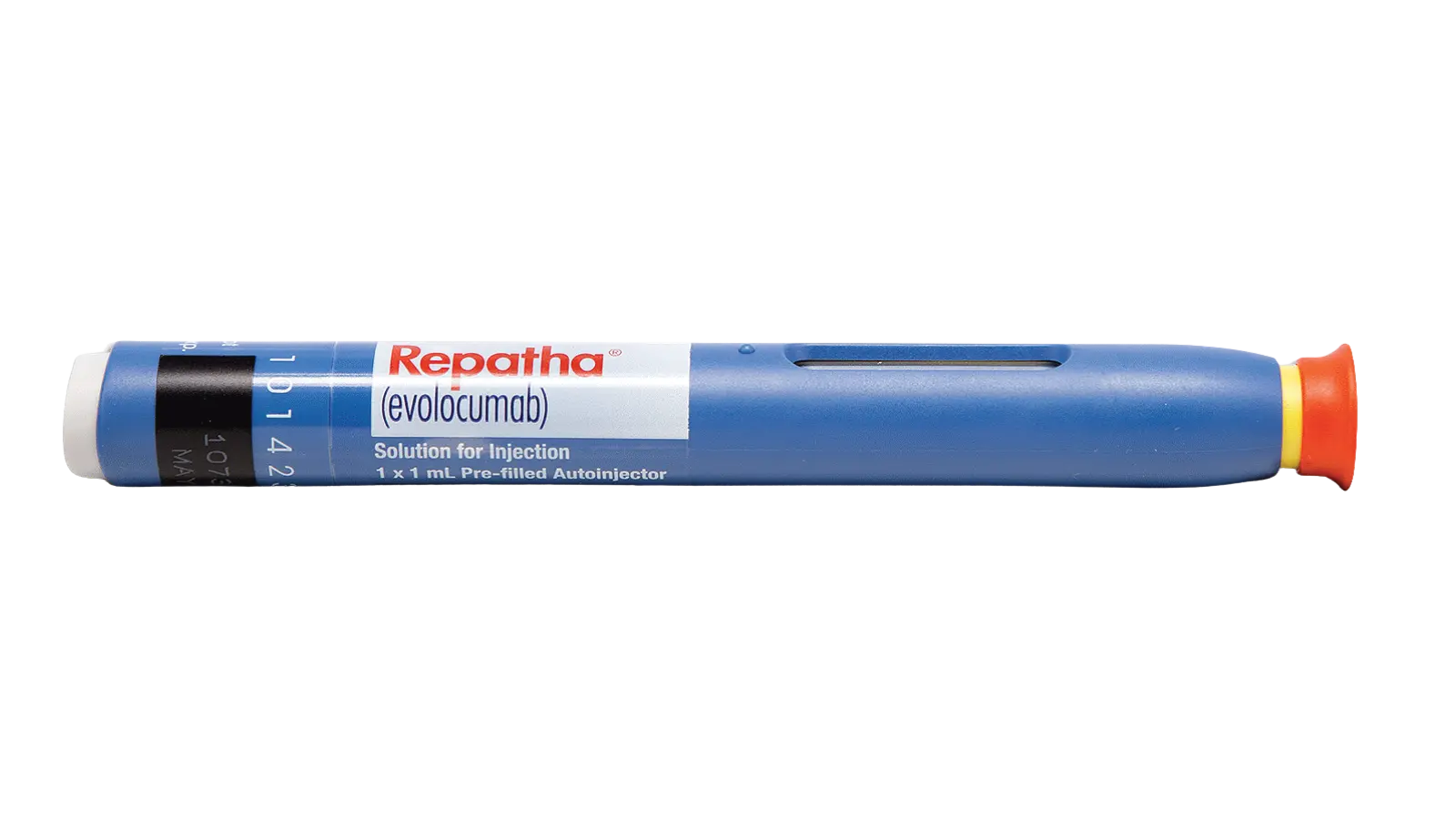
Evolocumab is given as a self-administered subcutaneous injection, either 140 mg every 2 weeks or 420 mg once monthly. It is reliably effective, the long-term safety record is strong out to 8 years, and the cardiovascular benefit grows with longer exposure.
What This Means If You're Considering Evolocumab
The hardest part of starting evolocumab usually isn't the medicine. It's getting the prescription, navigating insurance, and getting follow-up labs scheduled to confirm the drop and tune therapy. Instalab's Repatha Prescription Review ($99) pairs you with a licensed physician who reviews your records, prescribes evolocumab if it's appropriate, and tracks your lipid response over time.