
Evolocumab Injection: How Two Dosing Schedules Reach the Same LDL Drop
Within the first year of starting evolocumab, about 95% of patients see their LDL cholesterol drop by half or more, a consistency rare in cardiology drugs. The other 5% still drop, just less dramatically. Almost no one on this drug fails to respond.
Statins reduce LDL on average too, but the spread is wide; some people drop substantially while others barely move. Evolocumab is more like a switch. The protein it targets, PCSK9, is one of the body's main brakes on LDL clearance. Block the brake and the liver pulls cholesterol out of the blood far faster than it does on its own.
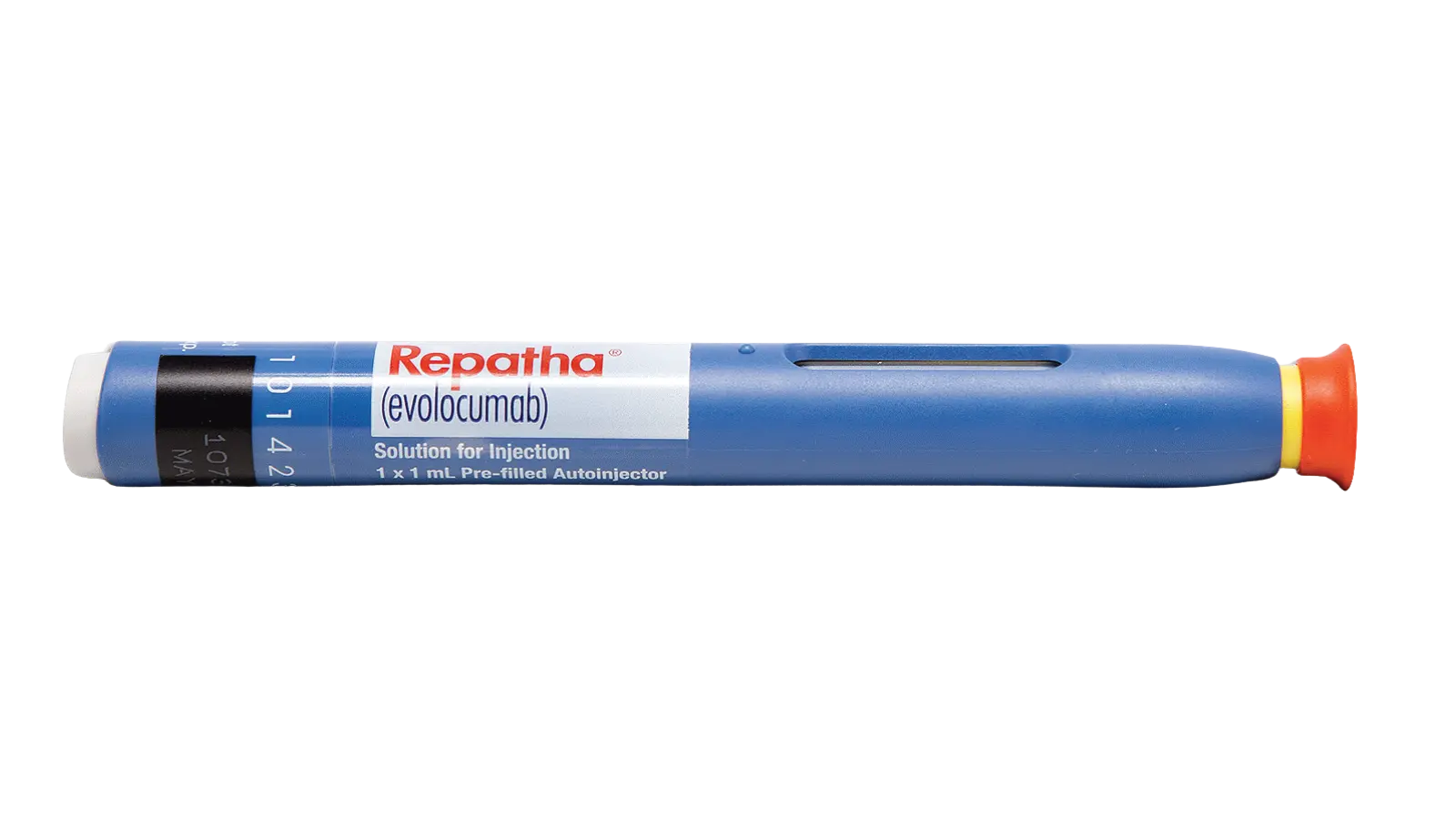
Evolocumab is the generic name for Repatha, a subcutaneous monoclonal antibody given every two weeks or once a month. This is what those two schedules look like in practice, what the injection itself feels like, and what years of follow-up actually show.


Two Schedules, Same Result
The drug comes in two FDA-approved dosing options. Both reach the same LDL reduction; the difference is how often you inject.
| Dose | Frequency | Volume per Visit | Best For |
|---|---|---|---|
| 140 mg | Every 2 weeks | One 1-mL prefilled pen | People who want smaller, more familiar volumes per shot |
| 420 mg | Once monthly | Three 1-mL injections in ~30 minutes | People who want fewer dosing occasions per year |
| Either | Comparable LDL drop | Subcutaneous | Adults on max-tolerated statin who still need LDL lowering |
A pooled phase 3 analysis of 3,146 patients found the two regimens produce comparable LDL drops, a finding that has held up in U.S. patients with type 2 diabetes, Chinese patients on stable statin therapy, and across age, sex, race, and risk-category subgroups.
Pharmacokinetic modeling explains why the schedules converge. After either dose, peak LDL suppression occurs at week one to two, and the drug's effective half-life is 11 to 17 days. The 420-mg monthly dose is a 3x bigger bolus given over a longer interval, so average drug exposure across the dosing interval works out roughly equivalent.
Many clinicians prefer the every-two-weeks regimen since trough levels at the end of the dosing interval can be slightly higher and a missed dose is less consequential.
What Happens After the Injection
The drug works fast. Within four hours of an injection, blood PCSK9 is almost completely suppressed. The LDL drop lags a bit because liver cells need time to surface more LDL receptors, the molecules that pull cholesterol out of circulation. Peak LDL reduction shows up around week one or two, and by week four the median patient sits at 66% below baseline.
Across long-term studies, that reduction holds. In a 4-year extension trial of 1,324 patients, median LDL stayed 57% below baseline at year four, only four percentage points off the 61% reduction seen at year one. The drug doesn't lose effect with chronic exposure. Patients who stay on it stay at their lowered LDL.
The Injection Itself
Evolocumab is given subcutaneously, the same kind of shot as insulin. The needle is short, the volume is small, and the autoinjector pen handles dosing once you press it against your skin.
Injection-site reactions are the most common side effect, showing up in real-world pharmacovigilance and trial data more than any other adverse event. Typical symptoms are pain, redness, bruising, swelling, and occasionally small skin nodules at the injection site.
In trials, these reactions are mostly mild and rarely cause anyone to stop the drug. Documented injection-site reactions, including nodular ones, typically resolve within days. In long-term follow-up, the rate of injection-site reactions decreases over time rather than increasing.
The other commonly reported side effects are flu-like symptoms (fever, sore throat, runny nose, or chills in the day or two after a shot) and muscle aches. Muscle pain occurs at rates similar to placebo in controlled trials, and significantly lower than with statins or ezetimibe.
How Hard Does It Lower LDL, Really
The 66% median LDL reduction at week 4 is the headline figure. The full distribution is worth understanding. In a FOURIER subanalysis of 21,768 patients, during the first year of treatment:
- 99.5% had any reduction in LDL
- 97.9% had a 30% or greater reduction
- 94.7% had a 50% or greater reduction
- 0.5% (about 1 in 200) had no apparent response
The few non-responders aren't well understood, and demographic or clinical factors don't appear to reliably predict who will fall in this group. The flip side is that the drug works the same way across nearly every patient subgroup studied: across age, sex, race, ethnicity, glucose tolerance status, baseline LDL level, and statin intensity.
For perspective, that 66% reduction lands most patients in territory that diet, exercise, and oral lipid-lowering drugs alone rarely reach. In the GLAGOV trial, patients on statin therapy with mean LDL of 93 mg/dL dropped to a time-weighted mean of 37 mg/dL on evolocumab over 76 weeks, and that drop was associated with measurable regression of coronary plaque.
Prescribed by a licensed physician. Sent to your pharmacy.
What the Cardiovascular Outcomes Look Like
LDL reduction matters because it translates into fewer heart attacks and strokes. The pivotal trial was FOURIER, which randomized 27,564 patients with established atherosclerotic cardiovascular disease to evolocumab or placebo on top of statin therapy. Over a median 2.2 years of follow-up, evolocumab reduced first major adverse cardiovascular events by 15%. Counting total events rather than just first events shifted the figure to an 18% reduction, including 26% fewer myocardial infarctions, 23% fewer strokes, and 22% fewer coronary revascularizations. For every 1,000 patients treated for three years, evolocumab prevented 22 first events and 52 total events.
The benefit was larger in patients at higher baseline risk. In a subgroup of 5,711 patients who'd had a heart attack within the prior 12 months, evolocumab reduced the primary composite endpoint by 19% and the death/MI/stroke composite by 25%. Absolute risk reduction over three years in this subgroup was 3.7%, more than triple the reduction seen in patients with remote MIs.
Across PCSK9 inhibitors as a class, a meta-analysis of 38 trials found a 17% reduction in major adverse cardiovascular events. Cardiovascular and all-cause mortality, however, were not reduced in this dataset, a finding consistent across more recent network meta-analyses. The drug prevents events; it doesn't yet have follow-up long enough to show mortality benefit.
Long-Term Safety
The 4-year OSLER-1 extension trial followed 1,324 patients on continuous evolocumab and tracked safety alongside efficacy. Several findings stand out.
- Persistence on therapy was 79% over a mean exposure of 44 months
- No neutralizing antibodies to evolocumab were detected at any point
- The annualized rate of new-onset diabetes was 4% in the standard-of-care group versus 2.8% in the evolocumab group
- Adverse event frequency did not rise with cumulative exposure; if anything, injection-site reactions and hypersensitivity events declined over time
The lack of a glycemic signal is notable because PCSK9 inhibition lowers LDL into ranges that some clinicians worried might destabilize membrane function or insulin sensitivity. The data so far don't bear that worry out.
Who This Drug Is For
Evolocumab is approved for adults with established atherosclerotic cardiovascular disease, primary hypercholesterolemia, or familial hypercholesterolemia (heterozygous or homozygous) who need additional LDL reduction beyond a maximally tolerated statin and ezetimibe. The clinical guideline math tips toward evolocumab when:
- LDL stays at 70 mg/dL or higher on a high-intensity statin plus ezetimibe
- Recent myocardial infarction (within 12 months) raises baseline cardiovascular risk substantially
- Familial hypercholesterolemia drives baseline LDL well above 100 mg/dL despite combination oral therapy
- Statin intolerance prevents reaching guideline targets through statins alone
The decision is rarely about whether evolocumab works; it nearly always does. The decision is whether the cumulative cardiovascular risk justifies the cost and the once-or-twice-monthly injection routine. For high-risk patients with stubbornly elevated LDL on optimized oral therapy, the math usually says yes.
What This Means If Your LDL Won't Budge
If you're on a high-intensity statin plus ezetimibe and LDL still sits above 70 mg/dL, evolocumab is the most evidence-backed next step in 2026. The data are unusually solid: tens of thousands of patients in pivotal trials, more than four years of continuous-exposure follow-up showing no waning effect, and a side effect profile that hasn't worsened with cumulative exposure. The injection itself is, for almost everyone, a non-event after the first few weeks.
Instalab's Repatha Prescription Review ($99) pairs you with a licensed physician who handles prescribing, prior authorization, and ongoing lipid monitoring. The same physician helps choose between the every-two-weeks and once-monthly schedule based on your response and tolerance.