
Microdose Tirzepatide: Why 5 mg Is the Lowest Maintenance Dose in the Trials
Even 5 mg of tirzepatide once a week cut body weight by 15% over 72 weeks in a 2,539-person trial of adults with obesity, with 85% of people losing at least 5% of their starting weight. That dose is already on the low end of what the manufacturer studied. Anything below 5 mg as a long-term maintenance dose has almost no published outcome data.
That gap is where "microdose tirzepatide" lives. The phrase usually refers to compounded or off-label dosing schedules that sit below 5 mg per week, sometimes at 2.5 mg or even 1 mg, marketed as a way to capture the appetite suppression and modest weight loss without the gastrointestinal side effects that hit hardest at higher doses.
The pitch is appealing. The evidence base behind it is much thinner than the marketing suggests.


The Doses Phase 3 Trials Studied
The full clinical development program for tirzepatide, called SURPASS for diabetes and SURMOUNT for obesity, evaluated three maintenance doses: 5 mg, 10 mg, and 15 mg once weekly. Every trial used the same dose-escalation pattern. People started at 2.5 mg, then stepped up by 2.5 mg every 4 weeks until they reached the assigned maintenance dose.
The 2.5 mg starting dose exists for tolerability, not effect. It is studied only as a stepping stone, with people typically holding at it for 4 weeks before advancing. The 5 mg dose is the lowest dose any Phase 3 trial has tested as long-term maintenance therapy.
That distinction matters because someone microdosing at 2.5 mg long-term is taking a dose the trials only tested for 4 weeks at a time, in service of working up to a higher dose. Population pharmacokinetic modeling describes tirzepatide with a roughly 5-day half-life, supporting once-weekly dosing across the studied range, but the modeling itself is built on data from the 2.5/5/10/15 mg pen sizes.
What 5 mg Tirzepatide Does
Across the obesity trials, 5 mg per week is already a remarkably effective dose:
- Mean weight loss at 72 weeks of 15% from baseline body weight, compared with 3% on placebo
- Roughly 85% of people lose at least 5% of body weight at 5 mg, versus 35% on placebo
- HbA1c reduction in diabetes trials of about 1.9 percentage points from baseline at 5 mg
- A 31 to 52% rate of reaching HbA1c below 5.7%, the prediabetes-to-normal threshold
Compared head-to-head with semaglutide 1 mg (the standard dose for the comparator drug at the time), tirzepatide 5 mg led to 1.9 kg more weight loss and a 0.15-percentage-point greater HbA1c reduction in a Phase 3 trial of 1,879 patients. A 2024 network meta-analysis pooling 28 trials and 23,622 participants found that even tirzepatide 5 mg produced more weight loss than every studied semaglutide dose: 5.27 kg of loss at 5 mg tirzepatide versus a range of 2.52 to 4.97 kg across semaglutide doses from 0.5 to 2.0 mg.
The benefits are not subtle even at the lowest tested maintenance dose.
How "Microdose" Tirzepatide Usually Gets Made
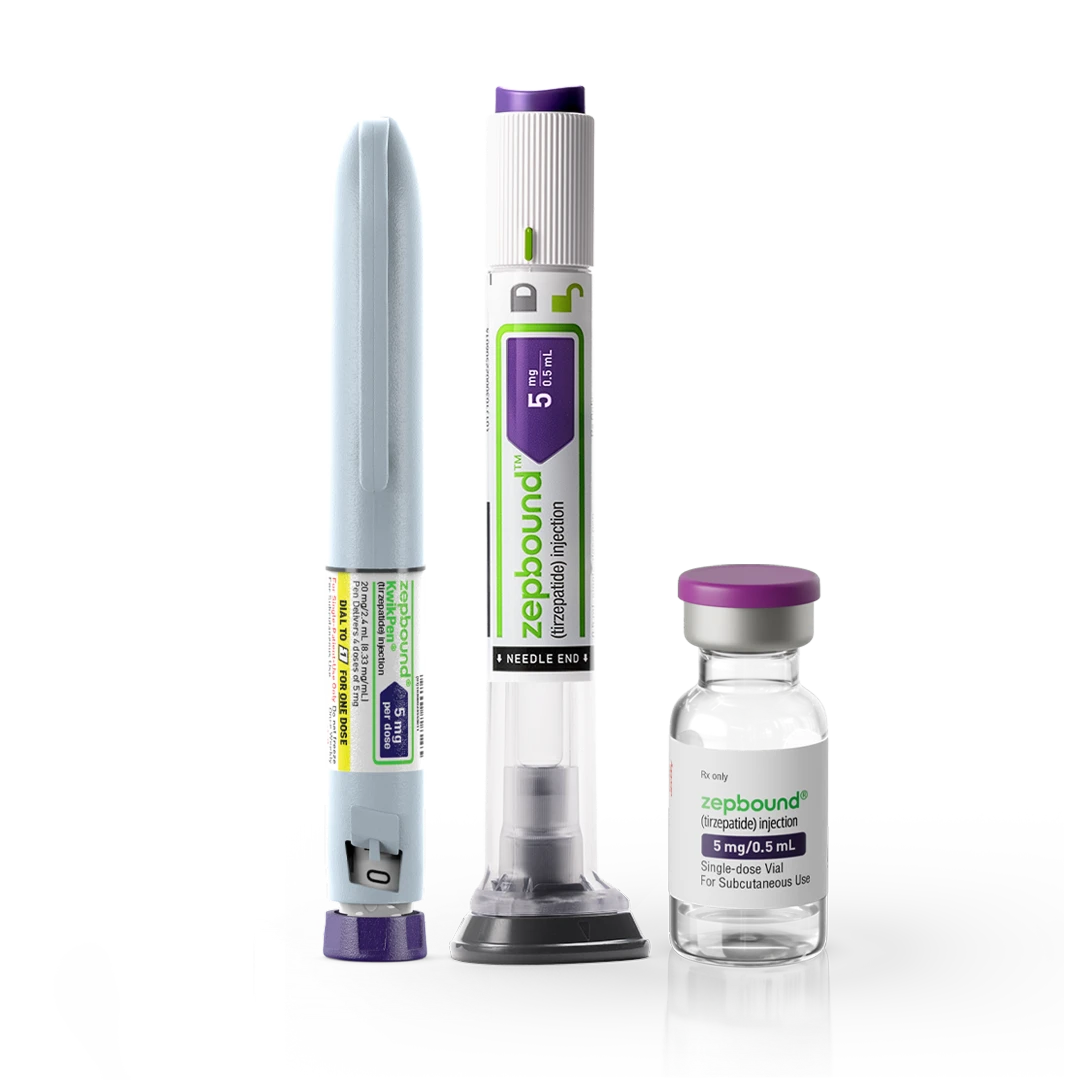
Compounded tirzepatide is the typical vehicle for sub-5-mg dosing in the U.S. market. During periods of brand-name shortage, compounding pharmacies have produced tirzepatide formulations at doses outside the approved manufacturer pen sizes (2.5, 5, 7.5, 10, 12.5, and 15 mg), and sub-therapeutic protocols such as 1 mg, 2.5 mg held indefinitely, or every-other-week scheduling most commonly come through this channel.
A 2025 analysis of FDA Adverse Event Reporting System data covering 81,078 GLP-1 receptor agonist reports found that compounded products were associated with higher reporting odds for several outcomes compared with FDA-approved versions: 2.8-fold for abdominal pain, 1.6-fold for diarrhea, 6.3-fold for suicidality, and 3.4-fold for cholecystitis. The same analysis flagged markedly higher signals for preparation errors, prescribing errors, contamination, and compounding-related issues, with reporting odds ratios from roughly 4 to 49 across these categories. Hospitalization odds were 2.4-fold higher for compounded products than for the FDA-approved formulations.
Dosing errors are the most consistent safety signal in real-world tirzepatide use overall. A FAERS analysis covering 65,974 reports from 2022 to early 2025 found that "incorrect dose administered" was the most frequent adverse event and rose 8-fold over three years, from 1,248 reports in 2022 to 9,800 in 2024. Off-label use also appears as a common adverse event signal in the same dataset.
Prescribed by a licensed physician. Sent to your pharmacy.
Why Lower Doses Look Tempting
Tirzepatide's gastrointestinal side effects are dose-related and concentrated in the escalation period. In the SURMOUNT-1 obesity trial, treatment discontinuation due to adverse events rose from 2.6% on placebo to 4.3% at 5 mg, 7.1% at 10 mg, and 6.2% at 15 mg.
In the SURPASS-1 diabetes trial, nausea ranged from 12 to 18% across the three tirzepatide doses versus 6% on placebo, with diarrhea at 12 to 14% versus 8% and vomiting at 2 to 6% versus 2%. The dose-response is real, and the desire to find a sweet spot below 5 mg is understandable for someone tolerating 2.5 mg fine but suffering at 5 mg.
The problem is that the trials don't tell you what 2.5 mg does over 72 weeks. They tell you what it does over 4 weeks of titration before moving up.
A 2019 Phase 2 dose-escalation study compared three different titration algorithms over 12 weeks and found that slower escalation reduced gastrointestinal events without losing efficacy at the target maintenance dose. Slowing the climb is a documented way to improve tolerability. Stopping the climb early, at a sub-maintenance dose, is not what was tested.
What the Evidence Doesn't Cover
There are no Phase 3 trials evaluating tirzepatide doses below 5 mg as long-term maintenance therapy in obesity or diabetes. Specifically:
- Whether 2.5 mg per week sustains weight loss as effectively as 5 mg over 72 weeks remains unstudied
- Whether weight regain happens faster at lower maintenance doses if treatment is paused remains unknown
- Whether the cardiovascular and metabolic benefits seen at 5 mg and above apply at lower doses has not been tested
- Whether longer titration schedules produce different long-term outcomes than the standard 4-weeks-per-step regimen has limited data
The body of evidence underpinning tirzepatide's approval is built on the 5/10/15 mg structure with a 2.5 mg starter step. Stepping outside that structure means stepping outside the evidence.
A Slower Titration Is the Sanctioned Workaround
For people who tolerate the standard escalation poorly, the documented approach is slower titration: stay at 2.5 mg longer than 4 weeks, or hold at 5 mg longer before moving up. Both happen routinely in clinical practice, with the goal of preserving the long-term weight loss seen in the trials on a different timeline.
Instalab's GLP-1 Program ($99) pairs you with a licensed physician who prescribes FDA-approved tirzepatide, tracks your tolerance to each dose step, and adjusts your dose schedule based on how you actually respond. The medication itself goes through a specialty pharmacy under your insurance, so the formulation is the one tested in SURMOUNT-1 and SURPASS, not a compounded version.
Two practical points worth knowing if you're starting:
- Slower is fine. The 4-weeks-per-step schedule is a minimum, not a maximum. Holding at 2.5 mg or 5 mg for longer than 4 weeks is not expected to reduce eventual efficacy based on clinical experience, though long-term outcome data on extended titration are limited.
- 5 mg may be your destination. Roughly 85% of trial participants hit clinically meaningful weight loss at 5 mg. There's no requirement to keep escalating if the result there is good enough.
What This Means If You're Considering Microdosing
The doses Phase 3 trials tested are 5, 10, and 15 mg once weekly, with a 2.5 mg starter for the first 4 weeks. The 5 mg dose is already enough to produce 15% weight loss in most people who respond. Doses below 5 mg as long-term therapy live outside the evidence base.
If your goal is fewer side effects, the documented path is slower titration on FDA-approved tirzepatide, not compounded sub-therapeutic dosing. The two routes look similar in marketing copy. They look different in FAERS data on adverse events, with compounded products carrying meaningfully higher odds of several gastrointestinal complications and quality issues.
Microdose tirzepatide is a phrase that travels well through telehealth marketing. The trials it claims to extend never tested doses below the standard 2.5 mg starter as long-term therapy. Five milligrams works, and we don't know what less works like.
References
9 studies- Tirzepatide Once Weekly for the Treatment of Obesity.
- Subcutaneously Administered Tirzepatide Vs Semaglutide for Adults With Type 2 Diabetes: A Systematic Review and Network Meta-analysis of Randomised Controlled Trials.
- Tirzepatide Versus Semaglutide Once Weekly in Patients With Type 2 Diabetes.
- Efficacy and Safety of a Novel Dual GIP and GLP-1 Receptor Agonist Tirzepatide in Patients With Type 2 Diabetes (SURPASS-1): A Double-blind, Randomised, Phase 3 Trial.
- Once-weekly Tirzepatide Versus Once-daily Insulin Degludec as Add-on to Metformin With or Without SGLT2 Inhibitors in Patients With Type 2 Diabetes (SURPASS-3): A Randomised, Open-label, Parallel-group, Phase 3 Trial.