
Repatha Drug Class: Inside PCSK9 Inhibition and the Drugs Built Around It
In the FOURIER trial, patients on a statin already had a median LDL of 92 mg/dL. After adding Repatha (evolocumab), the median dropped to 30 mg/dL, a 59% further reduction on top of what the statin had already done.
That is the calling card of Repatha's drug class: PCSK9 inhibitors. They are not statins or ezetimibe. They are a different mechanism that exists because of a genetic discovery few people outside cardiology talk about, and they are the most powerful LDL-lowering drugs ever approved.


What PCSK9 Inhibitor Means
Repatha (evolocumab) is a PCSK9 inhibitor. PCSK9 stands for proprotein convertase subtilisin/kexin type 9, which is a mouthful that nobody, including most cardiologists, actually says in conversation. Most just call them "PCSK9 inhibitors" or "PCSK9i."
The class includes three FDA-approved drugs.
Repatha and Praluent work the same way: they are lab-made antibodies that bind PCSK9 in your blood and neutralize it. Leqvio works one step earlier in the chain by stopping your liver from making PCSK9 in the first place.
There is also an oral PCSK9 inhibitor called MK-0616 in late-stage trials. Phase 2b data showed a 60.9% LDL reduction from a once-daily pill at the highest dose. If approved, it would be the first PCSK9 inhibitor you could swallow rather than inject.
Why Lowering PCSK9 Lowers LDL So Much
To understand what Repatha actually does, you need to understand what PCSK9 does.
Your liver pulls LDL out of your blood through receptors on its surface, which act like docking stations. Each receptor grabs an LDL particle, brings it inside the cell, then comes back out to grab another one. The same receptor cycles many times a day.
PCSK9 sabotages this process. It is a protein your own liver makes that binds to those LDL receptors and sends them to the cellular trash compactor instead of letting them recycle. Fewer receptors means less LDL clearance, and circulating LDL rises.
Repatha is an antibody designed to grab PCSK9 before it can dock with an LDL receptor. With PCSK9 blocked, your LDL receptors keep doing their job, receptor density on liver cells goes up, and circulating LDL falls.
The numbers are striking. Repatha cuts LDL by roughly 55 to 75% on top of a statin. A 2022 review covering all PCSK9 inhibitors put the class-wide range at 54 to 74%.
The class also lowers Lp(a), an independently atherogenic particle that statins barely touch. Pooled data from 10 evolocumab trials showed median Lp(a) reductions of about 22 to 25%.
What This Means for Heart Attacks and Strokes
LDL reduction is only useful if it actually prevents events. The FOURIER trial answered that question for Repatha specifically.
FOURIER followed 27,564 patients with established cardiovascular disease for a median of 2.2 years. Patients on Repatha plus a statin had a 15% lower risk of major cardiovascular events versus statin alone, and a 20% lower rate of the cardiovascular-death-or-MI-or-stroke composite. The benefit showed up across subgroups, including patients who already had low LDL at baseline.
A meta-analysis pooling data from 39 trials covering 66,478 patients confirmed the pattern across the class. Heart attack risk dropped 20% versus control, and ischemic stroke risk dropped 22%. Coronary revascularizations fell 17% in the same analysis.
A separate analysis of 35 trials with 45,539 patients reached similar numbers.
Mortality is where the picture gets murkier. Most pooled analyses show no clear all-cause mortality benefit from PCSK9 inhibitors over the trial periods studied. The likely explanation is that 2 to 3 years isn't long enough to see mortality differences when both arms are on aggressive statin therapy.
For peripheral artery disease patients, the effect was larger. Repatha cut major cardiovascular events with bigger absolute benefits because their baseline risk was higher, and it also reduced major adverse limb events like acute limb ischemia and amputations.
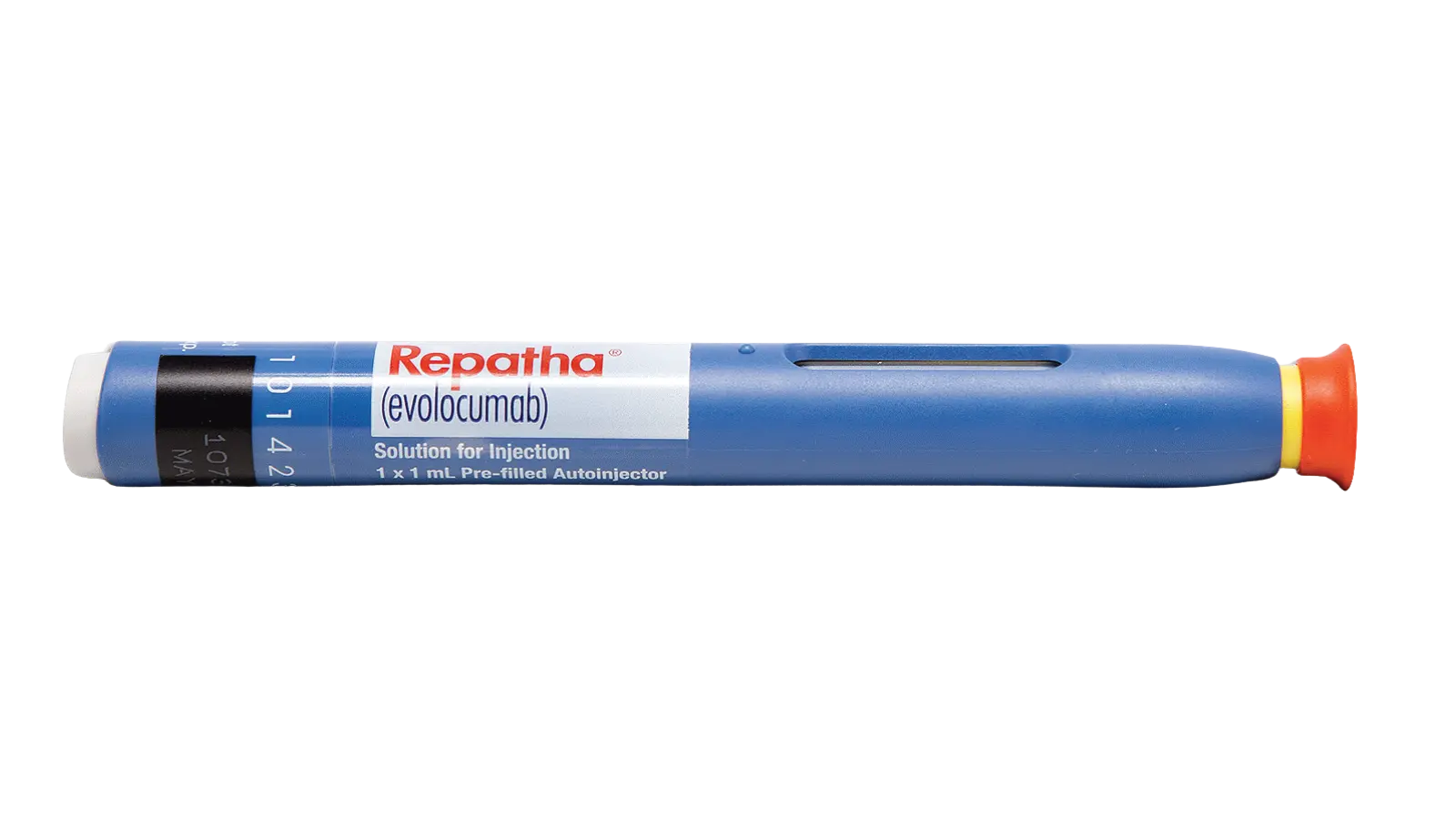
Prescribed by a licensed physician. Sent to your pharmacy.
Safety: What Five Years of Follow-Up Shows
The longest data on any PCSK9 inhibitor comes from OSLER-1, which followed evolocumab patients for up to 5 years. LDL stayed reduced by about 56% throughout. Yearly serious adverse event rates were around 7%, comparable to standard care, and 5.7% of patients stopped because of side effects.
Across the class, the safety pattern is consistent:
- Injection-site reactions. Most common side effect, usually mild
- Flu-like symptoms. Show up occasionally but rarely cause people to stop
- Muscle pain. Reported but not clearly higher than placebo, and lower than with statins
- No increase in new-onset diabetes across the class
- No clear increase in neurocognitive issues in most analyses, though one earlier meta-analysis flagged a possible signal that hasn't been confirmed in larger long-term studies
A FOURIER substudy looked specifically at patients who got their LDL down below 40 mg/dL, historically considered alarmingly low. There were no excess safety events, even at LDL concentrations under 8 mg/dL. The data support driving LDL much lower than current guidelines recommend.
Where Repatha Sits in the Treatment Lineup
PCSK9 inhibitors aren't first-line. Statins are, because they are cheap, well-studied, and effective for most people. Repatha and its cousins get added when statins aren't enough or aren't tolerated.
The 2019 ESC/EAS guidelines recommend PCSK9 inhibitors for very high-risk patients with atherosclerotic cardiovascular disease who don't reach LDL targets on maximum-tolerated statin plus ezetimibe. In practice, that often means people with familial hypercholesterolemia, prior heart attacks, rapidly progressing disease, or recurrent events despite high-dose statins.
Cost is the main barrier. Real-world discontinuation rates are higher than trial data, and the dropouts are mostly cost-driven rather than side-effect-driven.
For patients who actually need a 50 to 75% LDL reduction beyond what statins provide, the PCSK9 inhibitor class is the most effective tool available. Instalab's Repatha program pairs you with a licensed physician who handles the prescription, the candidacy decision, the lab work, and the dose follow-up.
What This Means If Your Doctor Mentions Repatha
If your doctor brings up Repatha, they are identifying you as someone whose LDL is dangerous and not coming down enough on existing therapy. The drug class is well-studied, the mechanism is clean, and the safety profile is reassuring through 5 years of follow-up.
What it isn't: a replacement for the lifestyle work or the statin foundation underneath. PCSK9 inhibitors work alongside the rest of your lipid management, not instead of it. The biggest cardiovascular benefits in the trials came from people already on statins who added Repatha on top.