
Repatha Medication: How an Antibody Cuts LDL by 60% Beyond Statins
In a trial of 27,564 statin-treated patients with cardiovascular disease, a single drug dropped average LDL cholesterol from 92 mg/dL to 30 mg/dL in under a year. The drug was Repatha, and "30 mg/dL" is the kind of number cardiologists once thought was unsafe to aim for. Eight years of follow-up later, that number stuck, and the heart attacks and strokes that didn't happen kept not happening.
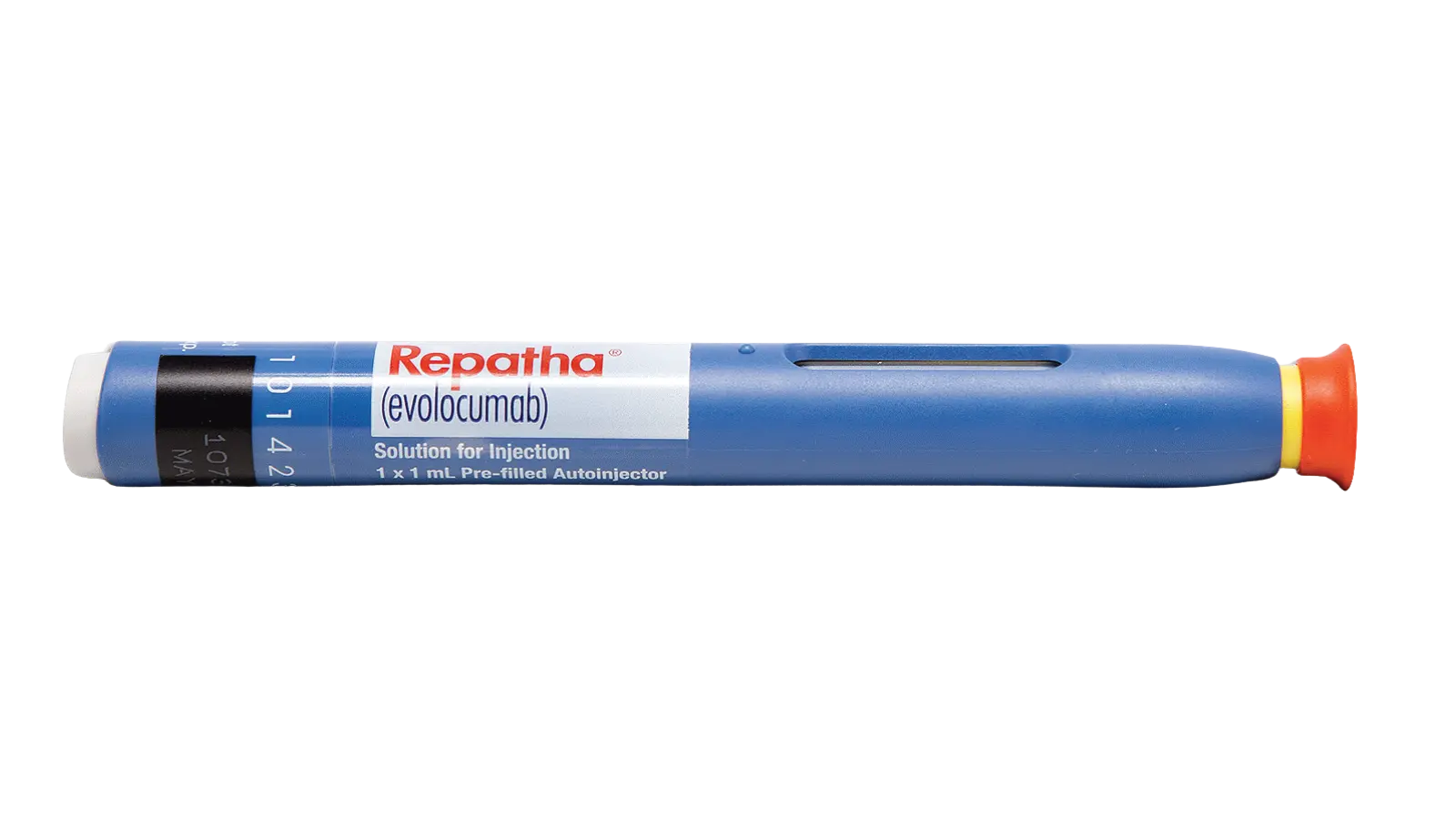
Repatha (generic name evolocumab) is a once- or twice-monthly injection that does something statins can't.
Statins slow how much cholesterol your liver makes. Repatha changes how aggressively your liver pulls existing cholesterol back out of your blood. The two drugs work in different places in the same pathway, which is why people who take both end up at LDL levels almost no diet or pill alone can reach.


What Repatha Actually Is
Repatha is a fully human monoclonal antibody, the same class of biologic drug used for autoimmune conditions and cancer. The target is a protein called PCSK9, which normally drags LDL receptors off liver cells and into the cellular trash.
Fewer LDL receptors mean less LDL gets cleared from your blood. Block PCSK9, and the receptors stick around longer, recycle back to the cell surface, and pull more LDL out of circulation.
The math works out to roughly 50–60% additional LDL reduction on top of whatever statin therapy you're already on. In one phase 3 trial, patients on diet alone dropped LDL by 56%; on low-dose atorvastatin by 62%; on high-dose atorvastatin plus ezetimibe by 49%.
Repatha doesn't replace statins. It piles on top of them.
The drug also lowers Lp(a), the genetically inherited lipoprotein that no statin meaningfully touches. PCSK9 inhibitors cut Lp(a) by about 21–25%, partly because clearing more LDL frees up LDL receptors to handle Lp(a) too.
What the Trials Found
The FOURIER trial enrolled 27,564 patients with atherosclerotic cardiovascular disease who were already on statins. Half got Repatha; half got placebo. After 2.2 years:
| Outcome | Effect with Repatha vs placebo |
|---|---|
| Primary composite (CV death, MI, stroke, unstable angina, revascularization) | 15% relative reduction (11.3% → 9.8%) |
| Key secondary (CV death, MI, stroke) | 20% relative reduction (7.4% → 5.9%) |
| Myocardial infarction | ~20–28% reduction across meta-analyses |
| Ischemic stroke | ~20–22% reduction across meta-analyses |
| Coronary revascularization | ~17–22% reduction across meta-analyses |
| All-cause mortality | No significant change |
The pattern repeated across at least four large meta-analyses pooling roughly 45,000 to 66,000 patients. Heart attacks fell by about 20–30%, strokes by 20–25%, and repeat artery procedures by 20–25%.
The number of patients who died from cardiovascular causes did not move in a statistically significant way.
When the FOURIER patients were followed for another six years in an open-label extension (FOURIER-OLE), the drug's earlier benefits compounded. Cardiovascular death dropped 23% over the longer follow-up window, and LDL stayed parked around 30 mg/dL with no new safety problems.
The benefit was largest in people at highest risk going in. Patients with peripheral artery disease saw a ~3.5% absolute risk reduction and a 42% reduction in major limb events.
Patients with a recent heart attack had absolute risk reductions of 3 to 4% over three years. People with metabolic syndrome got similar relative reductions but larger absolute benefit.
Who Repatha Is For
The label and the trial data point to four groups:
- Established cardiovascular disease. Prior heart attack, stroke, peripheral artery disease, or coronary revascularization, when statin therapy alone hasn't gotten LDL low enough.
- Familial hypercholesterolemia. A genetic condition that pushes LDL well above 190 mg/dL even on maximum statins. Repatha is approved for both heterozygous and homozygous forms.
- Statin-intolerant patients with high cardiovascular risk. People who genuinely can't tolerate statins because of muscle symptoms, but still need aggressive LDL lowering.
- Patients whose LDL won't move on statins plus ezetimibe. Some bodies just don't respond to oral cholesterol drugs the way the textbooks predict.
The drug is not a first-line cholesterol treatment. Statins remain cheaper, oral, and have decades of data. Repatha is what you reach for when statins, lifestyle, and ezetimibe haven't gotten you to your target.
The Mortality Question
The most-debated finding from FOURIER is what didn't happen. Despite preventing thousands of nonfatal heart attacks and strokes, Repatha did not produce a statistically significant reduction in all-cause or cardiovascular mortality during the original 2.2-year trial. Several network meta-analyses and one regulatory-data reanalysis raised concerns that evolocumab might be associated with slightly higher all-cause mortality compared to alirocumab or placebo, with risk ratios around 1.1 to 1.3.
Other analyses point out that FOURIER was stopped earlier than planned, and that beyond 2.5 years, the all-cause mortality curves started to favor placebo (4.8% in placebo vs 4.3% in evolocumab over the longer subgroup). The longer-term FOURIER-OLE extension, which followed patients out to 8.4 years, showed cardiovascular death declining 23% with continued evolocumab use, so the picture isn't simple.
The mainstream interpretation is that nonfatal event reduction is well established, mortality benefit is uncertain, and follow-up beyond 5 years matters because cardiovascular drugs typically need long horizons to move death rates. The FOURIER-OLE data trend in the right direction, but no one has run a single randomized trial powered specifically for mortality with PCSK9 inhibitors.
Prescribed by a licensed physician. Sent to your pharmacy.
Eight Years of Safety Data
This is where Repatha looks unusually clean. Across FOURIER, FOURIER-OLE, OSLER-1 (≈5 years, 4,951 patient-years), and pooled phase 2/3 extensions covering more than 6,000 patients, the safety signal is consistent:
- No excess diabetes. Most meta-analyses find no increase in new-onset diabetes. One large meta-analysis found a transient worsening in glycemic control in the first 24 weeks, with no excess after that.
- No neurocognitive harm. Despite early concerns about ultra-low LDL affecting brain function, neurocognitive events ran at ≤1% per year and showed no relationship to achieved LDL level.
- No liver or muscle toxicity. Liver enzyme elevations and muscle symptoms occurred at rates similar to placebo across pooled analyses.
- Injection-site reactions are slightly more common. About 2.1% with Repatha versus 1.6% with placebo in FOURIER.
- Antibody response is rare. No neutralizing antibodies have been detected in the long extension studies.
LDL levels under 25 mg/dL, sustained for years, did not produce safety problems in the trial population. Older patients (≥75 years), Asian cohorts, people with HIV, and pediatric homozygous FH patients all showed similar safety profiles to the broader trial population.
One systematic review using ClinicalTrials.gov data has argued evolocumab may slightly increase all-cause mortality, with a number needed to harm of about 213. This finding is contested and has not been reproduced in pooled extension data, but it's an open question worth flagging to your cardiologist.
What It Costs and How to Get It
Repatha's list price runs into the thousands of dollars per year before insurance, which has been a barrier even for patients who clearly need it; cost-effectiveness modeling at original list prices found PCSK9 inhibitors fell well outside conventional thresholds. Insurance coverage has improved since the drug's 2015 approval, and the manufacturer's copay assistance programs frequently bring out-of-pocket costs down sharply for commercially insured patients.
Getting Repatha typically requires:
1. A prescription from a cardiologist or lipidologist 2. Documentation of established cardiovascular disease, familial hypercholesterolemia, or statin intolerance 3. Documentation that maximum-tolerated statin therapy hasn't gotten LDL to target 4. Prior authorization from your insurance plan
Instalab's Repatha program handles the prescription, prior authorization, and ongoing lipid monitoring. The program pairs you with a licensed physician who reviews your lipid profile, prescribes the right dose, and tracks how your LDL and Lp(a) respond over time. Repatha is not a fire-and-forget medication; the response varies, and so does the dose schedule (140 mg every two weeks versus 420 mg monthly).
What This Means If You're Considering Repatha
The evidence for Repatha is unusually deep for a drug approved a decade ago. It does what it claims: it cuts LDL by roughly 60% beyond statins and reduces nonfatal cardiovascular events by 15–22%.
It has a long, clean safety record. It's expensive, requires injections, and the mortality benefit is still being argued about.
If you have established cardiovascular disease and your LDL is sitting at 80 or 90 mg/dL on a maximum-tolerated statin, this drug may be the cleanest path to getting your numbers somewhere your cardiologist would actually be happy with. If you're statin-intolerant or have familial hypercholesterolemia, the case is even stronger. If your LDL is already in the 50s without any side effects, the marginal benefit of adding Repatha is smaller and the cost-effectiveness gets harder to justify.
The right next step is a conversation with someone who can read your lipid panel, your risk profile, and your trial-data fluency in the same sitting.