
Repatha Reviews: How a 60% LDL Drop Translates Into Real-World Outcomes
In a trial of 27,564 people with established heart disease, Repatha pushed average LDL cholesterol from 92 mg/dL down to 30 mg/dL. That is roughly a 60% drop, achieved on top of statins, sustained for years. The same trial also showed an 18% drop in major cardiovascular events: heart attacks, strokes, and the procedures used to fix them.
Most articles you find about Repatha (evolocumab) are either drug-company brochures or anonymous internet comment threads. The actual reviews you should care about live inside randomized trials and real-world registries that have now followed hundreds of thousands of patient-years on this medication. The picture they paint is consistent: a powerful LDL-lowering injection with a side-effect profile that surprises people for how light it is, paired with hard outcome data that explain why cardiologists keep adding it to high-risk patients despite the price tag.


What Repatha Actually Does to Your Numbers
Repatha is a PCSK9 inhibitor, a once-or-twice-monthly injection that frees up LDL receptors on the liver so they can pull more cholesterol out of the blood. The effect is mechanical and large.
Across more than 25 randomized trials and 45,000-plus patients, the LDL drop sits in the 50–70% range when added to a statin. In the landmark FOURIER trial, median LDL on Repatha plus statin landed at 30 mg/dL, and the OSLER-1 extension showed that ~56% reduction held steady for five years with no drift in efficacy.
Other lipids move favorably too. HDL rises about 6–8%, and Lp(a), a genetically determined risk marker that statins barely touch, drops roughly 25%.
Hard Outcome Data: Heart Attacks and Strokes
LDL reduction is a surrogate. What patients want to know is whether the injection prevents the things that kill people. Across multiple meta-analyses pooling more than 100,000 patients, the answer is yes for non-fatal cardiovascular events.
PCSK9 inhibitors cut heart attack risk by about 20%, ischemic stroke by 22%, and coronary revascularization by 17%, with no signal of harm in liver enzymes, muscle problems, or new diabetes. The numbers come from a 2019 meta-analysis of 39 trials covering 66,478 patients and have been confirmed in a separate analysis of 35 trials. Translated into absolute terms, adding Repatha to a statin probably prevents about 12 heart attacks and 16 strokes per 1,000 high-risk patients treated for five years.
The reduction in total events, not just first events, is even larger. A FOURIER analysis of 4,906 total cardiovascular events found Repatha cut them by 18%: 22 first events and 52 total events prevented per 1,000 patients over three years. Patients who had already had one cardiovascular event were the ones who benefitted most in absolute terms.
What the data does not show is a clear all-cause mortality benefit. Most analyses find Repatha neutral on death rates over the 2–3 year trials we have, even as it cuts heart attacks and strokes. Whether longer follow-up changes that picture is still an open question.
| Outcome | Effect on Repatha (vs placebo, on top of statin) | Evidence Strength |
|---|---|---|
| LDL cholesterol | ~60% reduction (median 92 → 30 mg/dL) | Strong |
| Heart attack | 20% lower risk | Strong |
| Ischemic stroke | 22% lower risk | Strong |
| Coronary revascularization | 17–22% lower risk | Strong |
| Major cardiovascular events (composite) | 15–18% lower risk | Strong |
| All-cause mortality | No clear effect | Negative/neutral |
| Injection-site reactions | Slightly higher (2.1% vs 1.6%) | Strong |
What Side Effects Actually Look Like
The most common review you'll see online is "I expected it to feel like something, and it doesn't." That tracks with the data.
In FOURIER, injection-site reactions occurred in 2.1% of Repatha patients versus 1.6% on placebo. In a pooled analysis of 6,026 patients, overall adverse-event rates were 51% on Repatha and 50% on placebo, and liver enzymes, muscle enzymes, and bilirubin were unchanged. After a year of open-label extension, the gap stayed essentially zero.
Neurocognitive events were an early concern when LDL levels were pushed below historical norms. In the double-blind trials, those events were reported in 0.1% of Repatha patients versus 0.3% on control.
A FOURIER subgroup analysis specifically looked at people whose LDL fell below 0.5 mmol/L (around 20 mg/dL) on Repatha, a level that worried clinicians for years. Over 2.2 years of follow-up, no excess in serious adverse events, hemorrhagic stroke, new diabetes, or any other monitored safety outcome appeared compared with patients at higher achieved LDL. After five years on the drug in the OSLER-1 extension, about 5.7% of patients stopped because of an adverse event. No neutralizing antibodies were detected over almost 5,000 patient-years.
The injection itself is subcutaneous, into the abdomen, thigh, or upper arm, every two weeks at 140 mg or once monthly at 420 mg. Most reactions are mild redness or itching that resolves within a day or two.
Adherence and Real-World Use
Pill adherence in chronic disease is famously poor. Repatha appears to behave differently. In the OSLER-1 extension study, only 5.7% of patients on Repatha discontinued the drug for any adverse event over five years of follow-up. Across pooled safety analyses of more than 6,000 patients, discontinuation rates from side effects were similar between Repatha and control groups.
The likely reasons are mechanical. The injection schedule is twice monthly or monthly, not daily, and there is no perceived "muscle pain" feedback loop the way some patients experience with statins. The LDL number on the next blood draw is dramatic enough that patients can see something is happening.
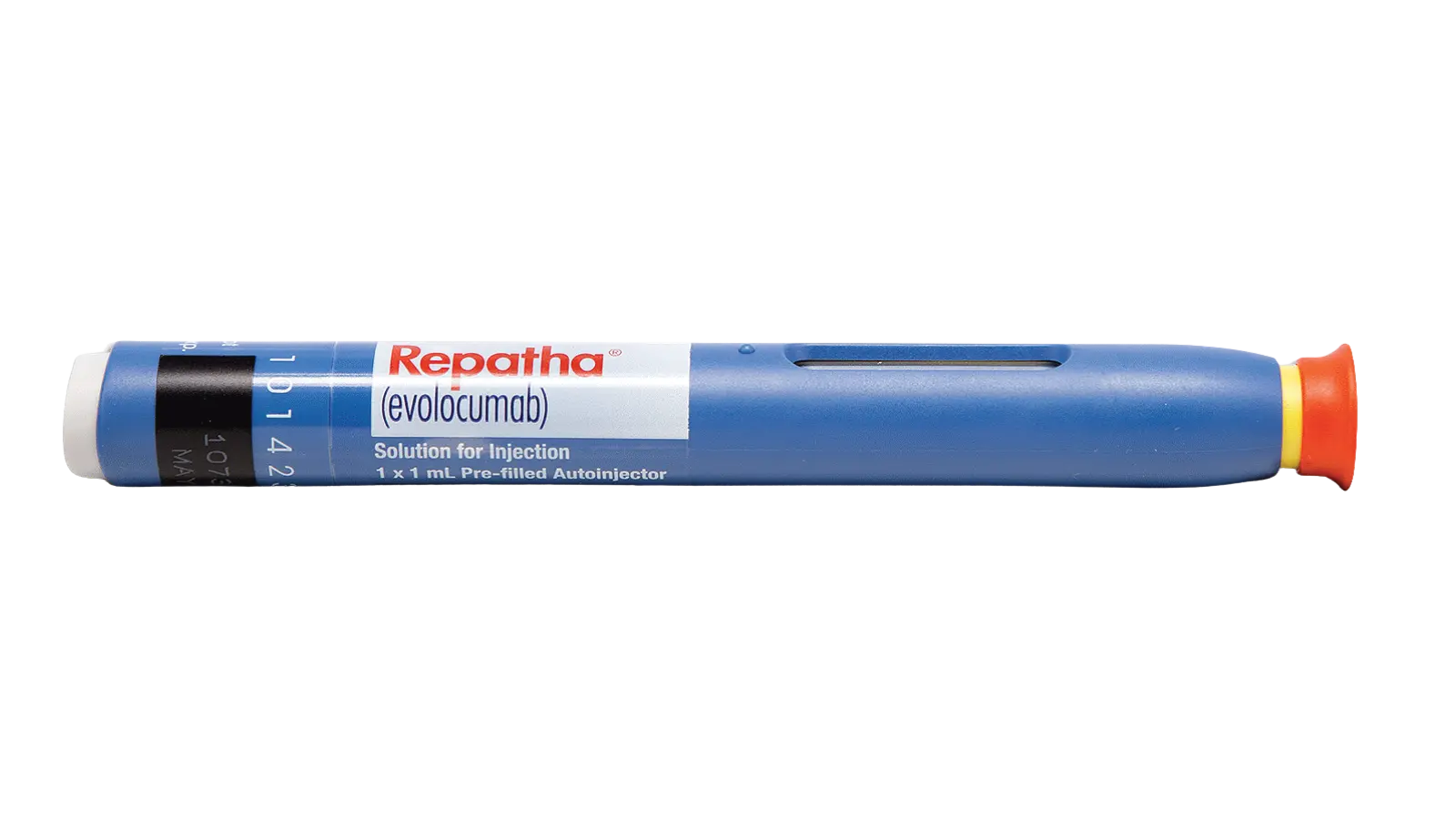
Prescribed by a licensed physician. Sent to your pharmacy.
Where Repatha Is Used (and Where It Is Not)
The biggest cardiovascular benefits show up in patients with the highest baseline risk. In a FOURIER subgroup of 3,642 patients with peripheral artery disease, Repatha cut major adverse limb events (acute ischemia, amputation, urgent revascularization) by 42%, with absolute benefits more than double those seen in lower-risk patients.
After acute coronary syndrome, Repatha plus high-intensity statin got 95.7% of patients to LDL targets by week 8, versus 37.6% on statin alone. Imaging studies after heart attack show coronary plaques shrinking and stabilizing, with thicker fibrous caps and smaller lipid cores.
For people with familial hypercholesterolemia, who often run LDL levels above 200 mg/dL despite maximum statin doses, Repatha brought down LDL by ~55% over 4.1 years of follow-up with adverse-event rates similar to statins. For statin-intolerant patients, GAUSS-2 found Repatha cut LDL by 53–56% with muscle-related side effects in 12% of patients, half the rate seen on ezetimibe.
Where Repatha does not obviously help is in lower-risk primary prevention. A 2022 network meta-analysis found PCSK9 inhibitors yielded little or no heart-attack and stroke benefit in moderate- and low-risk patients, even though LDL dropped just as much. The drug works in everyone biochemically; the absolute clinical payoff depends on how high your starting risk is.
How Repatha Compares With Other Options
A statin is the first step, then ezetimibe is usually next. Both are pills, both are cheap. PCSK9 inhibitors enter the picture when LDL stays above target despite maximally tolerated statin plus ezetimibe, or when patients cannot take statins at all.
Two PCSK9 inhibitors are FDA-approved: Repatha (evolocumab) and Praluent (alirocumab). They are similar in mechanism and LDL effect. Several head-to-head meta-analyses suggest alirocumab shows a more consistent all-cause mortality benefit, while Repatha shows the larger reductions in heart attack and revascularization. The clinical differences are modest, and choice often comes down to insurance, copay program, and physician familiarity.
Inclisiran, a newer PCSK9-targeting drug given twice yearly, has emerged as an alternative for patients who want fewer injections. Outcome data is still maturing.
Talking to a Doctor About Starting Repatha
Repatha is not a self-service medication. It is a prescription product with a process: lab work to confirm your LDL is genuinely above target on maximally tolerated therapy, prior authorization with most insurance plans, and ongoing monitoring to see whether the drug is doing what it should. Instalab's Repatha program handles that pipeline end to end: a licensed physician reviews your lipid panel and history, manages prior authorization, prescribes the dose schedule that fits your situation, and tracks your labs over time.
Before any of that, the cleanest first step is knowing your numbers. An ApoB test ($20) or Lp(a) test ($22) can clarify whether your cholesterol risk justifies a conversation about a PCSK9 inhibitor at all.
What the Reviews Add Up To
If you strip away the marketing on one side and the anecdotal forum posts on the other, what's left is a medication that does one thing extraordinarily well, with a side-effect profile that most patients don't notice, and outcome data showing meaningful reductions in heart attacks and strokes for the right patient. It is not a first-line drug, it is not for everyone, and it does not replace the work of getting your blood pressure, weight, and metabolism into reasonable shape. For patients whose LDL stays high despite doing everything else right, the trial and registry data are about as good as cardiovascular evidence gets.