
Wegovy vs Saxenda: 15.8% vs 6.4% in the Only Head-to-Head Trial
In the only head-to-head trial that pitted Wegovy directly against Saxenda, patients on Wegovy lost 15.8% of their starting weight after 68 weeks. Patients on Saxenda lost 6.4%.
That gap is roughly two-and-a-half times more weight loss with the once-weekly drug than with the once-daily one. And it shows up in nearly every other measure researchers tracked.
The two drugs are often discussed in the same breath because they belong to the same family. Both are GLP-1 receptor agonists, made by the same company (Novo Nordisk), both injected, both FDA-approved for chronic weight management. But the trial data tell a clearer story than the marketing usually suggests, and the practical differences go beyond how often you stick yourself with a needle.


How the Two Drugs Stack Up
Both drugs mimic GLP-1, a hormone your gut releases after a meal. They reduce appetite and food cravings, blunt the preference for energy-dense foods, and prompt the pancreas to release more insulin while suppressing glucagon (which raises blood sugar).
So far, so similar. The differences that matter for weight loss are about dose, dosing schedule, and how long the drug stays active in the body.
| Factor | Wegovy (semaglutide 2.4 mg) | Saxenda (liraglutide 3.0 mg) |
|---|---|---|
| Dosing | Once weekly injection | Once daily injection |
| Average weight loss vs placebo | 12 to 15% | 5 to 8% |
| FDA approval (weight loss) | 2021 | 2014 |
| GI side effect rate (head-to-head) | 84.1% | 82.7% |
| Discontinuation rate (STEP 8) | 13.5% | 27.6% |
| Cardiovascular outcome data | 20% MACE reduction | Limited |
The STEP 8 Trial
If you want one study to anchor this comparison, it is the STEP 8 trial. Published in 2022, it enrolled 338 adults with overweight or obesity but without diabetes and randomized them to weekly Wegovy 2.4 mg or daily Saxenda 3.0 mg for 68 weeks.
The headline numbers: Wegovy patients lost 15.8% of starting body weight, Saxenda patients lost 6.4%, a treatment difference of 9.4 percentage points (95% CI -12.0 to -6.8; P < 0.001).
The proportion of patients hitting bigger weight-loss targets diverged even more sharply. About 71% of Wegovy patients lost at least 10% of body weight, compared with 26% on Saxenda.
For 15% weight loss, the split was 56% versus 12%. For 20% weight loss, 39% versus 6%.
These margins held up in earlier trials too. A 52-week phase 2 study of 957 participants tested daily semaglutide at lower doses against the same Saxenda 3.0 mg comparator. Even at 0.4 mg daily, semaglutide produced 13.8% weight loss versus 7.8% with liraglutide.
Against placebo, weekly semaglutide 2.4 mg has consistently produced 14% to 17% weight loss across the STEP trial program in non-diabetic adults.
Side Effects: Less Different Than You'd Expect
The biggest surprise in the head-to-head data is how similar the side-effect rates look on paper. In STEP 8, 84.1% of Wegovy patients and 82.7% of Saxenda patients had gastrointestinal symptoms, mainly nausea, vomiting, diarrhea, or constipation. Most were mild or moderate and improved with time.
What did differ was tolerability. More than twice as many Saxenda patients (27.6%) dropped out of the trial as Wegovy patients (13.5%). The daily shot, the longer dose-titration period, and the slower onset of weight loss all likely contributed.
The pattern of specific GI complaints also differs in real-world data. A large analysis of FDA adverse-event reports found semaglutide had higher reporting rates for nausea, vomiting, diarrhea, and constipation, while liraglutide had higher reporting rates for upper abdominal pain and pancreatitis.
A 2023 database study of GLP-1 users for weight loss found increased rates of pancreatitis, bowel obstruction, and gastroparesis with the class as a whole, without clearly separating the two drugs.
Both drugs carry a boxed warning for medullary thyroid cancer based on rodent studies, though the human evidence remains uncertain. Both are also linked to gallbladder problems at higher rates than expected, likely because rapid weight loss promotes gallstones regardless of the cause.
Beyond Weight Loss
Wegovy's edge isn't just about pounds. The SELECT trial enrolled 17,604 adults with obesity and pre-existing cardiovascular disease but not diabetes, and found that weekly semaglutide cut the risk of major cardiovascular events by 20% over nearly 40 months. That includes cardiovascular death, non-fatal heart attack, and non-fatal stroke.
A long-term analysis of the same trial showed weight loss continued through about week 65 and stayed below baseline for four years (10.2% mean reduction at 208 weeks). Saxenda has not generated comparable cardiovascular outcome data at its 3.0 mg weight-loss dose.
The diabetes head-to-head trials add a parallel finding. The SUSTAIN 10 trial compared a lower dose of semaglutide (1.0 mg weekly) against a lower dose of liraglutide (1.2 mg daily) in 577 adults with type 2 diabetes. Semaglutide reduced HbA1c by 1.7 percentage points versus 1.0 with liraglutide, and patients lost 5.8 kg versus 1.9 kg.
The pattern held even at half the obesity-treatment dose.
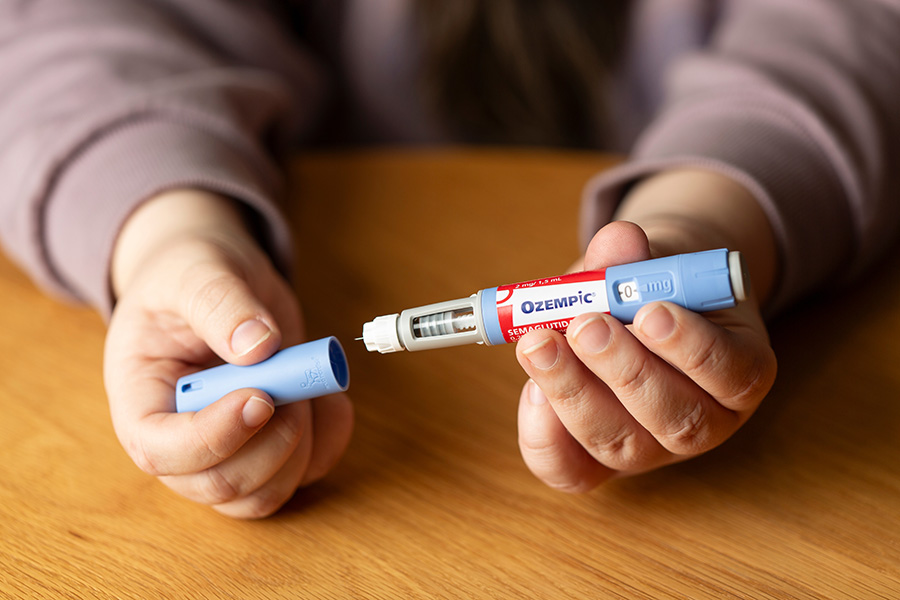
Prescribed by a licensed physician. Sent to your pharmacy.
What Happens When You Stop
This part rarely gets discussed when people compare the two drugs, but it should. Both work as long as you keep taking them.
The STEP 4 trial randomized people who had already lost weight on semaglutide to either continue the drug or switch to placebo. Over the next 48 weeks, the continuation group lost another 7.9% on top of their initial loss. The switch-to-placebo group regained 6.9% and saw waist circumference, blood pressure, and other cardiometabolic markers drift back toward baseline.
This isn't a Wegovy-specific finding. It is how every GLP-1 drug works.
Stop the medication, and your appetite signals return to whatever they were before. The same likely applies to Saxenda, though the long-term withdrawal data are more limited.
The practical implication is that if you start either drug, you should plan to stay on it indefinitely or have a maintenance strategy ready before stopping. Neither is a course of treatment that ends with a graduation date.
Cost and Access
List prices for both drugs are high (over $1,000 per month at retail in the U.S. without insurance). Saxenda has been on the market longer and sometimes carries lower negotiated prices. Wegovy is the newer drug, with much larger average weight loss in the trial data, which tends to show up favorably in cost-effectiveness analyses despite the higher list price.
Who Each Drug Actually Fits
Most patients starting GLP-1 therapy for weight loss today are placed on Wegovy or one of its competitors (tirzepatide), not Saxenda. The trial evidence and the dosing convenience both push that direction. A 2025 head-to-head trial actually found tirzepatide outperformed semaglutide too, with 20.2% versus 13.7% weight loss at 72 weeks, so Wegovy itself has a faster-acting rival.
Saxenda still has a few situations where it might be a reasonable choice:
- Patients who prefer daily routines over weekly ones, especially those concerned about a longer-acting drug if side effects appear
- Patients whose insurance covers Saxenda but not Wegovy
- Adolescents 12 and older, where Saxenda has FDA approval and longer real-world experience
- Patients who have struggled with semaglutide's GI side effects and want to try a different drug in the same class
If those situations don't apply, the trial data make a clear case for the once-weekly drug.
Starting GLP-1 Therapy
If you're sorting through which medication fits your situation, the question usually isn't just which drug works best in trials. It's which one your doctor will prescribe, how the dose is titrated, and whether your labs are tracked over the months it takes the drug to do its work. Instalab's GLP-1 Program ($99) pairs you with a licensed physician who handles the prescription, adjusts your dose as you go, and monitors lab values that matter (glucose, HbA1c, lipids) while you're on therapy.
Choosing Between Wegovy and Saxenda
The trial data make the broad answer clear: weekly semaglutide produces about two to two-and-a-half times more weight loss than daily liraglutide, with similar overall side-effect rates and lower drop-out rates. It also has cardiovascular outcome evidence that Saxenda can't match.
The narrower answer depends on your specific circumstances: insurance coverage, age, prior experience with GLP-1 drugs, and how you feel about a daily versus weekly injection. For most adults starting GLP-1 therapy in 2026, the evidence favors Wegovy. For a subset, Saxenda still makes sense, especially as a fallback when the more potent drug isn't accessible or tolerable.
Whatever the choice, neither drug is a short course. The weight comes back if you stop. Plan for the long term before you start either one.