
What Repatha Is Used For: The Four Patients Who Actually Need a PCSK9 Inhibitor
In the trial that earned Repatha its cardiovascular indication, patients on a statin saw their LDL cholesterol drop from a median of 92 to 30 mg/dL after 48 weeks, a 59% reduction. That is not a typical drug effect. It is the kind of number you see in laboratory studies of liver receptors, not in a 27,564-person clinical trial.
If you have stable cardiovascular disease and are already on the strongest statin you can tolerate, that extra LDL reduction translates into a 20% lower risk of having a heart attack, stroke, or cardiovascular death. That is what Repatha is for, in one sentence.
But the FDA has approved it for four specific groups of people, and the benefit looks very different across them. Here is who actually needs a PCSK9 inhibitor, and what the research says about how much it helps each one.


How Repatha Works in 30 Seconds
Repatha is the brand name for evolocumab, a monoclonal antibody given as a subcutaneous injection every two weeks (140 mg) or once a month (420 mg). Its job is to block a liver enzyme called PCSK9. PCSK9 normally tags LDL receptors for destruction; when it is blocked, those receptors stay on the surface of liver cells and pull more LDL particles out of your blood.
That is why LDL drops by roughly 60% across populations. It is also why Repatha lowers Lp(a), a separate lipid particle that shares the same receptor pathway, by about 25%.
The Four Approved Uses
| Patient Group | Why It's Used | LDL Reduction | Evidence Strength |
|---|---|---|---|
| Established cardiovascular disease, on statins | Cuts heart attack, stroke, revascularization | ~59% | Strong (FOURIER, 27,564 patients) |
| Heterozygous familial hypercholesterolemia | Reaches LDL goal when statins can't | 50-65% | Strong (multiple RCTs) |
| Homozygous familial hypercholesterolemia | Last-line LDL lowering for genetic resistance | 21-31% | Moderate (small trials, variable response) |
| Statin intolerance with high cardiovascular risk | LDL lowering when statins cause symptoms | 53-56% | Strong (GAUSS-2 trial) |
This is the most common reason cardiologists prescribe Repatha, and it is the use backed by the largest evidence base. The FOURIER trial randomized 27,564 patients with established atherosclerotic cardiovascular disease who were already on a statin and still had LDL at or above 70 mg/dL. After a median 2.2 years, evolocumab cut the primary composite outcome (cardiovascular death, heart attack, stroke, hospitalization for unstable angina, or revascularization) by 15%, and the harder secondary outcome (cardiovascular death, heart attack, or stroke) by 20%.
Pooled across 39 randomized trials covering 66,478 patients, PCSK9 inhibition reduces heart attacks by 20%, ischemic strokes by 22%, and coronary revascularizations by 17%. A separate analysis of 35 trials and 45,539 patients found a 28% reduction in heart attacks specifically.
The longer you take it, the more the benefit accrues. In the FOURIER open-label extension, patients who started Repatha at the original randomization had a 23% lower risk of cardiovascular death and a 20% lower risk of cardiovascular death, heart attack, or stroke at up to 8.4 years of follow-up, compared with patients who started later.
The benefit isn't the same for everyone with heart disease, though. Patients within two years of a recent heart attack saw a 20% relative and 3.4% absolute risk reduction over three years, while patients further out from their event saw only a 5% relative reduction. Patients with peripheral artery disease had a 21% relative reduction in cardiovascular events and 42% fewer major limb events. Patients with chronic kidney disease saw similar relative benefits, with greater absolute reductions as kidney function worsened.
The takeaway: Repatha helps most when you are at high baseline risk. Multiple recent heart attacks, multivessel disease, peripheral artery disease, or elevated Lp(a) all increase the absolute benefit.
Familial hypercholesterolemia (FH) is a genetic condition where one or both copies of the LDL receptor gene are broken. The result is lifelong, dangerously high LDL that doesn't respond well to standard treatment.
For heterozygous FH (one broken copy, the more common form), Repatha typically lowers LDL by 50-65% on top of statins, with the effect arriving fast and lasting. The RUTHERFORD-2 trial showed a 60% reduction at 12 weeks in 331 adults, and a 4-year follow-up of 300 severe FH patients confirmed sustained 55% reductions in the heterozygous group.
For homozygous FH (both copies broken), the response is smaller and depends heavily on whether any LDL receptor function remains. Two trials anchor what to expect: TESLA Part B showed a 31% LDL reduction in 50 patients over 12 weeks, and TAUSSIG followed 106 homozygous FH patients on Repatha for an average of 1.7 years and showed a 21% LDL reduction sustained over time, with some patients on apheresis able to discontinue that procedure.
Long-term efficacy holds up: in OSLER-1, patients followed for up to 4 years on Repatha maintained LDL reductions of 57-59% from baseline, with no neutralizing antibodies developing and no rise in adverse events with cumulative exposure.
If you have FH, this is where Repatha changes the calculus most. Standard statins plus ezetimibe often leave heterozygous FH patients with LDL above goal, and homozygous patients far higher still. Repatha gets many heterozygous FH patients to goal for the first time.
About 10-20% of patients can't tolerate effective doses of statins, usually due to muscle pain. The GAUSS-2 trial enrolled 307 statin-intolerant patients and randomized them to evolocumab or ezetimibe. Repatha cut LDL by 53-56%, compared with about 17% for ezetimibe, and muscle-related side effects were actually less common in the Repatha arm (12% versus 23%).
For patients with diabetes, who often have higher cardiovascular risk and tighter LDL targets, Repatha works equally well: a prespecified FOURIER analysis of 11,031 patients with diabetes showed the same relative cardiovascular risk reduction as in non-diabetic patients, with no worsening of blood sugar and no increase in new-onset diabetes.
This is a catch-all category for high cholesterol that hasn't yet caused a cardiovascular event but isn't controlled by maximum-dose statins. It overlaps heavily with the other three uses. The LAPLACE-2 trial showed Repatha added to moderate or high-intensity statin therapy lowered LDL from a baseline of 89-124 mg/dL down to 33-49 mg/dL, depending on the statin and dose.
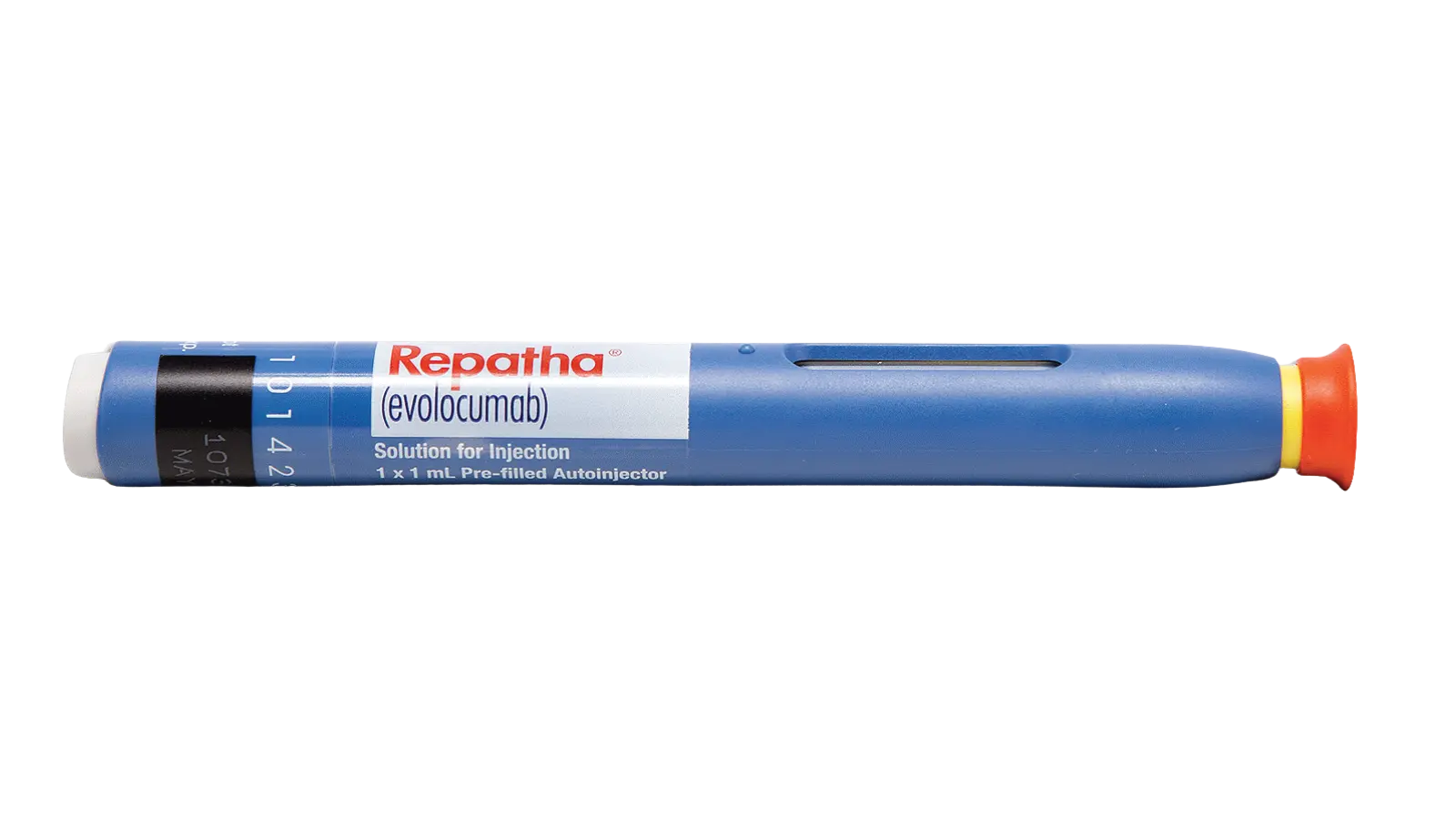
Prescribed by a licensed physician. Sent to your pharmacy.
How Low Is Too Low?
A reasonable concern with a drug this potent is whether driving LDL very low causes problems. The FOURIER analysis specifically looked at patients who hit LDL below 0.5 mmol/L (about 19 mg/dL), and the answer was reassuring: lower LDL meant lower event rates with no detectable safety signal across ten prespecified safety endpoints.
That holds up over time. In the FOURIER open-label extension at up to 8.4 years of exposure, rates of serious adverse events, new diabetes, hemorrhagic stroke, neurocognitive events, and muscle problems didn't exceed placebo rates from the original trial. Across 35 trials, PCSK9 inhibitors don't increase neurocognitive events, myalgia, new-onset diabetes, or liver enzyme abnormalities.
The most common Repatha side effect is injection-site reactions, which occur in about 2% of patients (versus 1.6% on placebo).
What Repatha Won't Do
Repatha is not a weight-loss drug. It is not a substitute for a statin in patients who can take one. It does not treat triglycerides primarily, though it modestly lowers them.
It also does not reduce all-cause mortality in trials run for two to three years, and meta-analyses show neutral effects on cardiovascular and total mortality during typical follow-up periods.
That last point is worth understanding. Repatha clearly prevents heart attacks and ischemic strokes. Whether that translates into longer life depends on how long you take it, your baseline risk, and how complete the picture eventually becomes. The FOURIER open-label extension data hint at a 23% lower cardiovascular death risk with longer exposure, but most trials simply weren't long enough to settle the mortality question definitively.
Should You Consider Repatha?
Repatha is meant for people whose LDL stays high despite a maximum-tolerated statin, where "high" depends on cardiovascular risk. If you have established heart disease and your LDL is still above 70 mg/dL on a statin, current guidelines support adding it.
If you have FH, it is often the first realistic chance at reaching goal. If you genuinely cannot tolerate statins and your cardiovascular risk is high, it is one of the few options that delivers comparable LDL reduction.
Instalab's Repatha Program pairs you with a licensed physician who reviews your lipid panel, prescribes Repatha if it fits, and monitors your labs and dose over time. The program handles the prescription, the lab follow-up, and the dose adjustments. The drug itself is sent to your pharmacy.
If you are not in one of the four groups above, Repatha is probably not what you need. Diet, exercise, and a statin do most of the work for most people. PCSK9 inhibition is the next tier, and it earns its place when the standard tier isn't enough.