
Zepbound Before and After: What 72 Weeks of Tirzepatide Does to Your Body
In SURMOUNT-1, the largest trial of Zepbound for weight management, people without diabetes lost an average of 20.9% of their body weight on the 15 mg dose over 72 weeks. For someone starting at 240 pounds, that's roughly 50 pounds.
That's the average. The reality across thousands of trial participants is more textured: weight loss starts within weeks, accelerates through month 6, slows by month 12, and depends heavily on which dose you tolerate.
Body composition shifts in ways the scale doesn't show. Blood pressure, triglycerides, waist size, and HbA1c move alongside the weight. And when people stop taking the drug, much of what they lost comes back.


The Headline Numbers by Dose
Tirzepatide, the active ingredient in Zepbound, was tested across the SURMOUNT trial program in roughly 6,000 adults with obesity, with and without type 2 diabetes. The pattern across trials is consistent: more drug, more loss, with the curve flattening above 10 mg.
| Population (Trial) | Duration | 5 mg | 10 mg | 15 mg | Placebo |
|---|---|---|---|---|---|
| Obesity, no diabetes (SURMOUNT-1) | 72 wks | -15.0% | -19.5% | -20.9% | -3.1% |
| Obesity + prediabetes (SURMOUNT-1 long-term) | 176 wks | -12.3% | -18.7% | -19.7% | -1.3% |
| Obesity + type 2 diabetes (SURMOUNT-2) | 72 wks | not tested | -12.8% | -14.7% | -3.2% |
| After lifestyle run-in (SURMOUNT-3) | 72 wks | not tested | not tested | -18.4% additional (10 or 15 mg pooled) | +2.5% |
| Continued treatment (SURMOUNT-4) | 88 wks total | not tested | not tested | -25.3% (10 or 15 mg pooled) | -9.9% |
| Chinese adults (SURMOUNT-CN) | 52 wks | not tested | -13.6% | -17.5% | -2.3% |
A few patterns are worth pulling out. People with type 2 diabetes lose less than people without, about a third less at the same dose. The 15 mg dose adds modest extra benefit over 10 mg in most trials, so doctors often stop escalating once a patient is responding well at 10 mg.
The 5 mg dose, sometimes called the "starter" dose, still produces meaningful loss. It isn't a stepping stone.
In SURMOUNT-1, 91% of people on the 15 mg dose lost at least 5% of their body weight, and 57% lost at least 20%. On placebo, 35% hit the 5% mark and 3% hit 20%.
When the Changes Happen
The popular framing is that GLP-1 drugs "shut down food noise" within days. The trial data tells a slower story.
SURMOUNT-1's protocol included a 20-week dose-escalation period before participants reached their full assigned dose. The headline 20.9% loss at 15 mg accumulates across 72 weeks, with the steepest portion typically falling in the middle months.
A rough timeline based on the trial protocol:
- Weeks 1 to 4. Starter dose, 2.5 mg. Hunger and food cues drop. Weight loss is real but small, often 2 to 4 pounds.
- Weeks 4 to 20. Dose escalation. Most people climb through 5, 7.5, 10, 12.5, and possibly 15 mg in monthly steps.
- Weeks 20 to 36. Full dose reached. The fastest weight-loss period for most people.
- Weeks 36 to 72. The curve flattens. Loss continues for some, but more slowly. Plateau typically arrives.
If you're 6 weeks in and disappointed, the trial data suggests the next several months usually do the heavy lifting. SURMOUNT-1 kept dosing through 72 weeks even for slower responders, and many of them ended up well past the 5% threshold.
What's Coming Off: Fat, Visceral Fat, and Some Lean Mass
The scale measures total weight. DXA scans during the trials show what's happening underneath.
A 22-trial meta-analysis of GLP-1 drugs found that lean mass loss makes up about 25% of total weight loss, meaning roughly three-quarters of what comes off is fat. Tirzepatide produced the largest fat-mass reductions of any drug in the class, but it also produced the largest absolute lean-mass losses; lean preservation was best with liraglutide.
In the SURMOUNT-1 body-composition substudy, this pattern held: fat mass dropped substantially more than lean mass. How much of the lean-mass loss is muscle versus water depends on the person; resistance training and adequate protein during weight loss appear to mitigate it.
Two findings stand out. Visceral fat, the deep belly fat that wraps around organs and drives metabolic disease, drops disproportionately. In a SURPASS-3 MRI substudy, liver fat fell by about 8 percentage points on the pooled 10 and 15 mg doses, alongside large reductions in visceral and subcutaneous abdominal fat.
In a 28-week head-to-head trial against semaglutide, tirzepatide produced significantly larger fat-mass reductions.
So the "before and after" picture is not a smaller body. It's a body with less fat in the places that matter most for cardiometabolic risk.
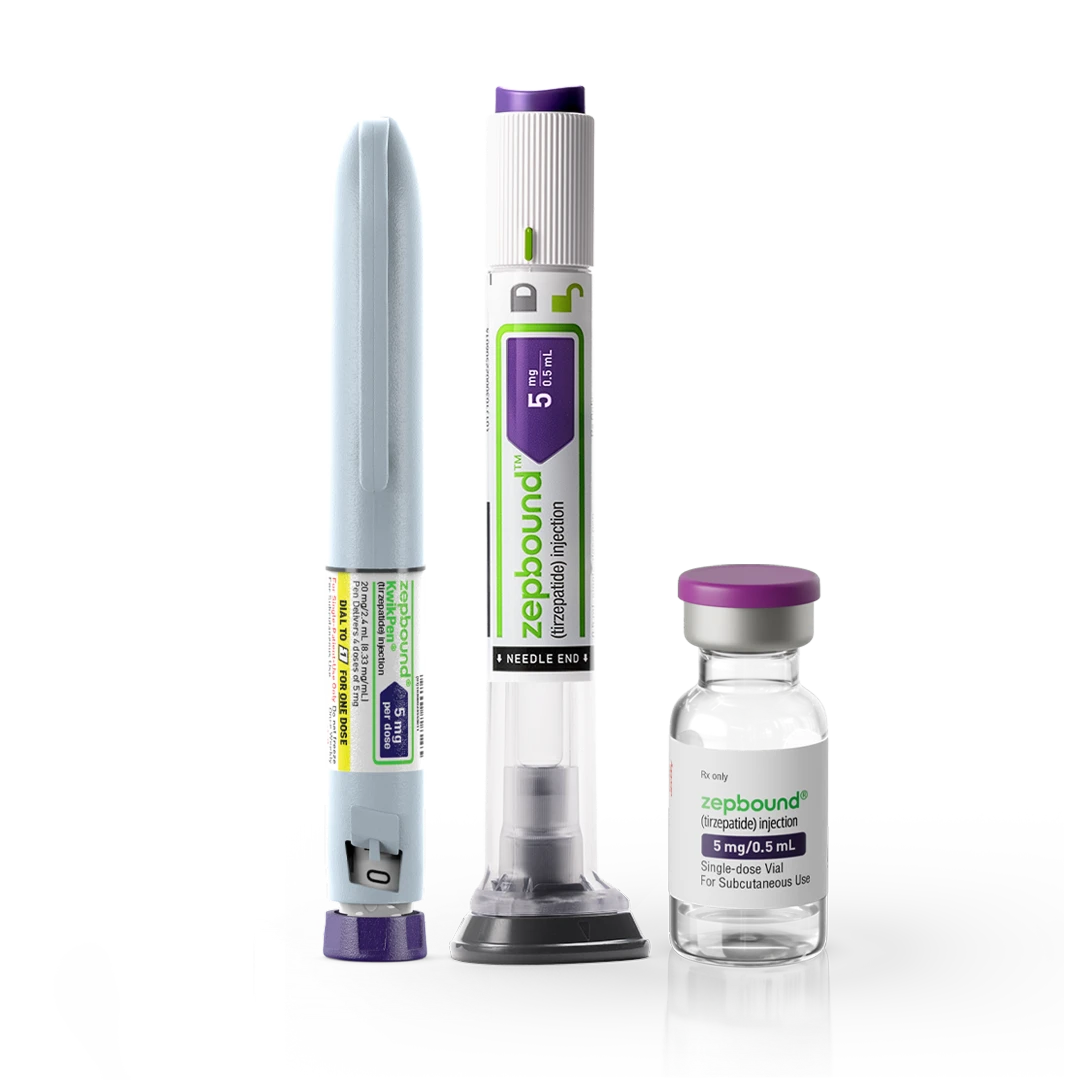
Prescribed by a licensed physician. Sent to your pharmacy.
What Else Moves: Blood Pressure, Triglycerides, Waist, A1c
Weight is the most visible change. The cardiometabolic numbers that show up on a lab panel often move just as dramatically.
- Blood pressure. Across the SURPASS T2D trials, systolic BP fell by 2.8 to 12.6 mmHg depending on dose. The SURMOUNT-1 ambulatory BP substudy confirmed the drop in obesity (without diabetes) wasn't a clinic artifact. The reduction is primarily mediated through weight loss, with some weight-loss-independent contribution.
- Triglycerides. Drop substantially across the dose range, with larger reductions at higher doses.
- LDL cholesterol. Drops modestly, with HDL nudging up.
- Waist circumference. In SURMOUNT-5, the head-to-head against semaglutide, tirzepatide reduced waist by 18.4 cm versus 13.0 cm with semaglutide over 72 weeks.
- HbA1c. In people with type 2 diabetes, tirzepatide drops A1c by 1.9 to 2.6 percentage points across the SURPASS program. In people with obesity and prediabetes, three years of treatment cut progression to type 2 diabetes from 13.3% on placebo to 1.3% on tirzepatide.
A SURMOUNT-1 post-hoc analysis estimated tirzepatide reduces the 10-year predicted risk of atherosclerotic cardiovascular disease in adults with obesity, driven mostly by improvements in cardiometabolic risk factors.
What Happens After You Stop
The single most consequential finding for anyone starting Zepbound is what happened in SURMOUNT-4. Researchers ran 670 people through 36 weeks of open-label tirzepatide, where they lost an average of 20.9% of their body weight. They then randomized half to keep taking the drug and half to switch to placebo for another 52 weeks.
The placebo group regained an average of 14% of body weight; the tirzepatide group lost an additional 5.5%. By the end of the 88-week trial, total weight reduction was 25.3% on the drug and 9.9% off it. Roughly 90% of people on tirzepatide held at least 80% of their initial weight loss, compared with 17% of those switched to placebo.
A real-world cohort of 18,386 propensity-matched patients on tirzepatide or semaglutide found that discontinuation within the first year was common, though most patients hit at least 5% weight loss before stopping. The implication is that obesity behaves like hypertension or high cholesterol: the drug controls the condition while you take it. Stop, and the underlying biology reasserts itself.
What This Looks Like If You're Starting Zepbound
The numbers above are averages from people who completed 72 weeks of treatment. Real outcomes vary: some people lose 30% of their body weight, some lose 5%.
Roughly 4 to 7% discontinued treatment in SURMOUNT-1 because of side effects, with the events occurring primarily during dose escalation. Nausea and diarrhea are the most common; vomiting also shows up during dose increases. Almost all events are mild to moderate.
The before-and-after photos circulating online tend to come from people on 10 or 15 mg who tolerated dose escalation and stayed on the medication for a year or more. The trial data points to a simple recipe: get to a dose you tolerate, then give it 6 to 9 months for the curve to bend. The prescription works as a long-term tool, not a 12-week reset.
Instalab's GLP-1 Program ($99) pairs you with a licensed physician who prescribes Zepbound and tracks your labs as you escalate dose.