
Do Balance Video Games Actually Prevent Falls?
If a stepping or balance video game is the thing that finally gets you to keep doing fall-prevention exercise, that may be its whole value. A 2026 review pooling 9 randomized trials in adults 60 and older found an overall lower fall rate with exergaming, good retention and moderate adherence in the studies that reported them, and no serious intervention-related harms. Read it as a way to deliver the balance and strength work already known to lower fall risk, not as an upgrade over it. Where the evidence stays thin is the outcome you actually fear: the fall that breaks something.


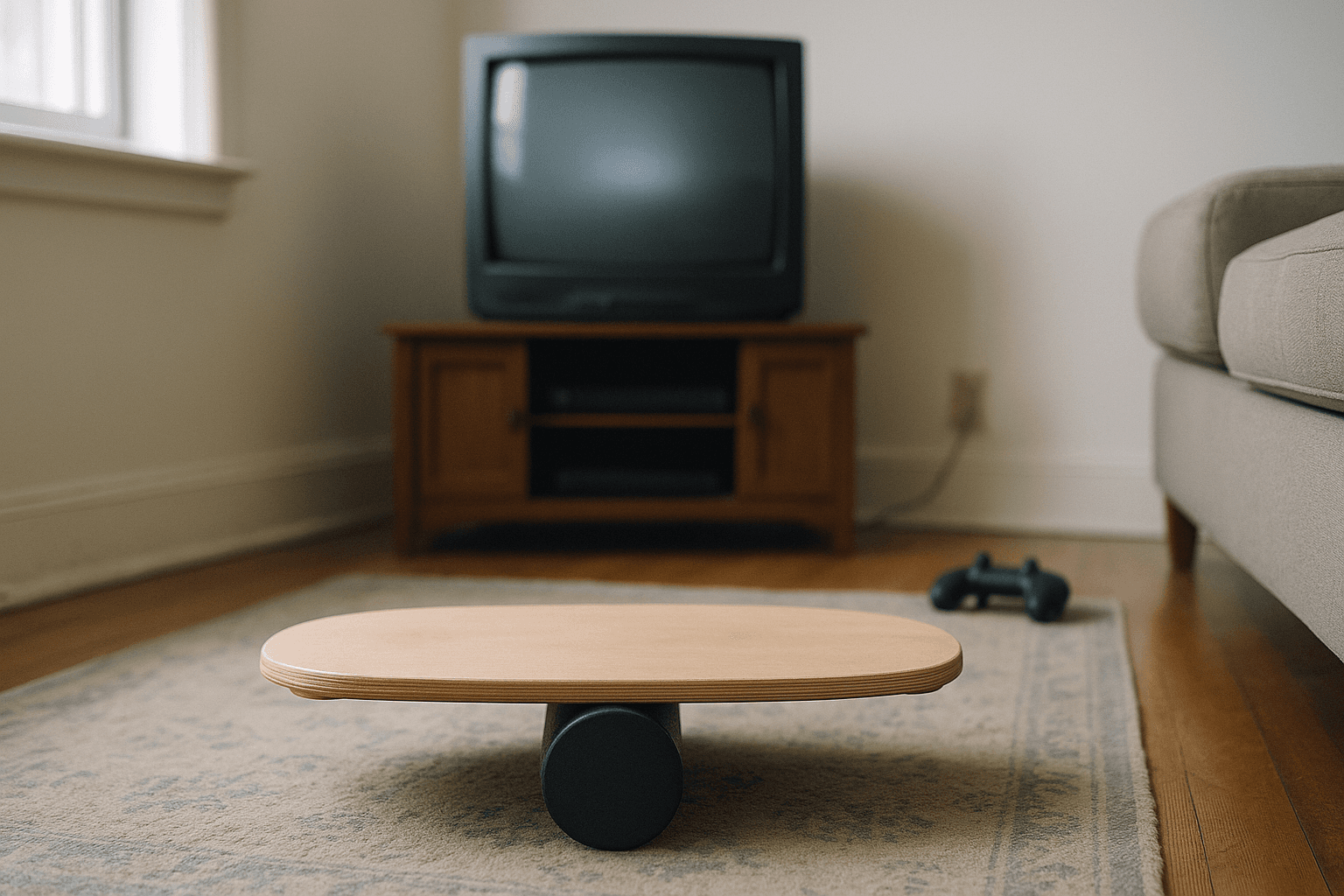
For an older adult who is willing and able to exercise, a stepping or balance video game now looks like a legitimate way to do fall-prevention work, not a gimmick. A 2026 systematic review in JMIR Aging pooled 9 randomized trials with 1,385 people aged 60 and older and found a lower overall fall rate with exergaming. The pooled estimate was exploratory and heterogeneous, so read it as a direction, not a precise effect. The clearest single estimate comes from a large home-based step-training trial of 769 independently living adults aged 65 and older, which found a lower fall rate over a year. The catch is what none of this yet proves.
Judge it as a delivery method, not a technology
The assumption worth turning over is that the screen and sensors do something special. The better question is whether they get you to do the movement that already works. The largest trial found no improvement in secondary physical or cognitive outcomes, which fits a plainer interpretation: the current evidence does not prove a special technology effect beyond getting people to practice challenging movement. And movement works. Balance and functional exercise cuts fall rates by about 24% in older adults, high-certainty evidence. Both the U.S. Preventive Services Task Force and NICE point at-risk groups toward structured exercise programs. Neither singles out exergaming. A few small comparisons with active exercise controls favored exergaming for fall rates, but the certainty was low, so this still does not prove a game beats a well-designed balance-and-strength program. A stepping or balance game is best judged as one way to package proven exercise. Its edge, if it has one, is that you'll keep doing it.
The fall you fear most is the least proven
Most fall research counts total falls. The one that changes a life is the injurious fall: a fracture, a head injury, or a fall that needs medical care. Here the exergaming evidence nearly disappears. The review found limited data from a single study suggesting a possible reduction, but the confidence interval included no benefit. Quality-of-life and concern-about-falling results were limited or inconsistent too. Conventional exercise has stronger direct evidence on this outcome: the two-year Ossébo trial in at-risk women aged 75 to 85 found fewer injurious falls (hazard ratio 0.81, 95% CI 0.67 to 0.99). Game-based balance work that trains similar capacities could plausibly help. But that was supervised conventional training, not exergaming, and even it was not risk-free: it recorded five injurious falls tied to the intervention. Plausible is not proven. It also matters who these games were tested on. The strongest home trial enrolled independently living adults and excluded people with neurological, acute psychiatric, or cognitive impairment; several smaller trials included Parkinson disease, frailty, or mild cognitive impairment, but injury evidence in those higher-risk groups remains thin. If you're doing this to avoid a fracture, you're acting on reasonable extrapolation, not direct proof.
Whether you'll keep at it
An exercise plan only helps if you do it, and this is where exergaming earns its attention. In the studies that reported implementation, median retention was 87%, and participants completed a median 69% of the minimum prescribed exercise dose. No serious intervention-related harms were reported, although one noninjurious fall occurred during guided step training. A common reason fall-prevention exercise fails in practice is that people stop. A format someone finds engaging enough to repeat can matter even if it isn't a better training technology.
| Outcome | What the evidence showed | How confident to be |
|---|---|---|
| Total fall rate | Fewer falls overall in an exploratory pooled analysis: IRR 0.53 (95% CI 0.41 to 0.68), and 0.74 (95% CI 0.56 to 0.98) in the single largest trial | Low to moderate; heterogeneous |
| People who fall by 12 months | At 12 months versus usual care, RR 0.75 (95% CI 0.61 to 0.92) in one comparison | Low; one 12-month comparison |
| Adherence and safety | Median 87% retention, median 69% adherence to the minimum prescribed dose, and no serious intervention-related harms reported | Limited but favorable |
What it does and doesn't justify
The evidence supports trying exergaming as one way to do fall-prevention exercise, especially if a game is what gets you moving when standard routines haven't. It doesn't support trading clinician-guided balance, strength, or multifactorial fall care for a game alone, and it doesn't prove the game beats a well-designed conventional program. What would change that verdict is easy to name: large, rigorous trials with long follow-up that compare exergaming directly with strong balance-and-strength programs and are powered to measure injurious falls and harms in frailer, higher-risk people. Until those report, these games are a promising way to turn proven movement into something people may keep doing, while the proof on preventing the fall that breaks a bone is still owed.