
Is Repatha a Statin? Why the Mechanism Matters More Than the Brand Name
The 27,564 patients in the FOURIER trial were already taking a statin when their doctors added Repatha. Their LDL cholesterol fell another 59%, from a median of 92 mg/dL down to 30 mg/dL.
That single setup tells you most of what you need to know about the relationship: Repatha isn't a statin. It's the drug doctors reach for when statins aren't doing enough on their own.
Most people who get prescribed Repatha are already on a statin, or have been told they can't tolerate one. The two drugs treat the same problem, dangerously high LDL cholesterol, but they reach the cholesterol pathway from completely different angles.


The Short Answer: No, and Here's Why It Matters
Statins are a class of drugs that block an enzyme in the liver called HMG-CoA reductase. That enzyme is the bottleneck step in how your body manufactures cholesterol. Slow it down, and the liver makes less cholesterol and pulls more out of the bloodstream.
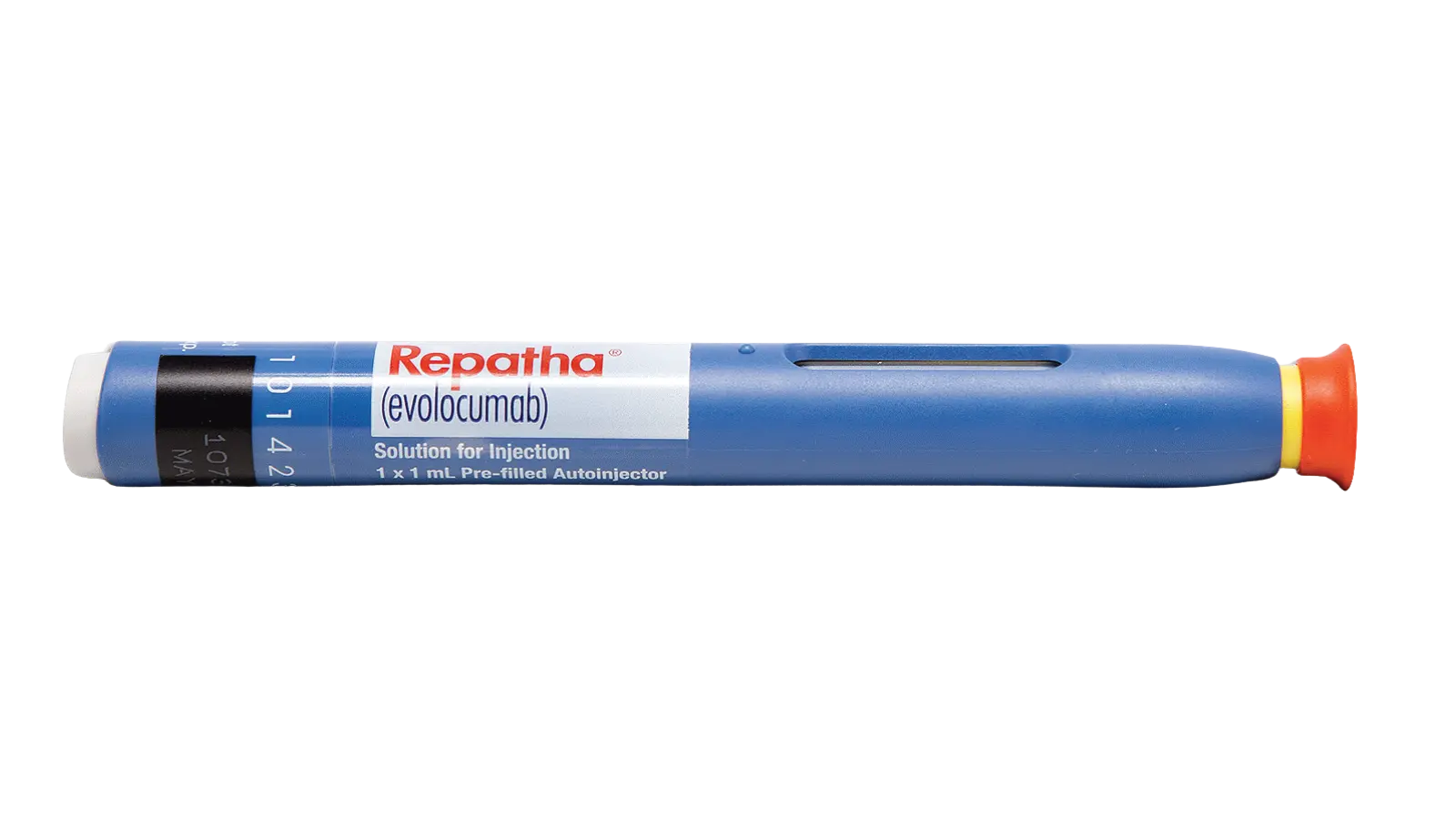
Repatha (the brand name for evolocumab) does something completely different. It's a lab-engineered antibody that binds to a protein called PCSK9.
PCSK9's job is to destroy LDL receptors on liver cells, the very receptors that pull LDL out of your blood. Block PCSK9, and those receptors live longer and clear more cholesterol.
Same destination, completely different route. That's why doctors think of them as separate drug classes, and why one isn't a substitute for the other in the way two statins might be.
| Feature | Statins | Repatha (evolocumab) |
|---|---|---|
| Drug class | HMG-CoA reductase inhibitors | PCSK9 inhibitors |
| How it works | Blocks cholesterol production in the liver | Preserves LDL receptors so they keep clearing cholesterol |
| Form | Daily pill | Injection every 2 weeks or once a month |
| Typical LDL reduction | 30 to 50% (depends on dose) | 50 to 60% on its own; another 59% on top of a statin |
| Main side effect concern | Muscle aches, possible new-onset diabetes | Mild injection-site reactions |
| Cost | Inexpensive (generic) | Expensive (biologic) |
How Much Does Repatha Actually Lower LDL?
The numbers separate Repatha from statins more clearly than the mechanism does. Across multiple large analyses, PCSK9 inhibitors lower LDL cholesterol about 50 to 70%, including in patients who can't tolerate statins. When added on top of a statin, Repatha cuts another 59 to 63% off LDL.
Multiple meta-analyses confirm PCSK9 inhibitors achieve substantially greater LDL reductions than statins alone. In one statin-treated trial, evolocumab brought time-weighted LDL down to 36.6 mg/dL versus 93.0 mg/dL on statin alone, a difference that translated to plaque regression.
This is where the drug-class distinction stops feeling academic. A statin can lower LDL from 130 to 80 mg/dL. Repatha can take it from 80 to 30 or lower.
For someone with established heart disease whose target is below 55 mg/dL, that's the difference between hitting goal and missing it.
Does the LDL Drop Translate to Fewer Heart Attacks?
This is the question that mattered most when Repatha was approved. Lower numbers are nice, but do they prevent the actual events?
The FOURIER trial answered that. Over 2.2 years in 27,564 patients with established cardiovascular disease, adding Repatha to a statin reduced the composite of cardiovascular death, heart attack, stroke, hospitalization for unstable angina, and revascularization by 15%. The harder cluster of cardiovascular death, heart attack, and stroke fell by 20%.
The benefit held up across patient subgroups. People with peripheral artery disease, prior stroke, metabolic syndrome, diabetes, and chronic kidney disease all saw similar relative reductions, and often larger absolute benefits because their baseline risk was higher. Patients with more recent heart attacks, multiple prior heart attacks, or residual multivessel disease showed about a 20% relative risk reduction with absolute benefits over 3% at three years.
The follow-up extension, FOURIER-OLE, tracked patients for up to 8.4 years and confirmed the early signal. People originally randomized to evolocumab had a 23% lower rate of cardiovascular death compared to those who started later.
"But What About How Low Is Too Low?"
When patients hear that median LDL on Repatha can land near 30 mg/dL, the first reaction is often: that has to cause problems. The trials were designed to look for exactly that.
Patients in FOURIER who reached LDL below 20 to 30 mg/dL had the lowest event rates and showed no excess of serious side effects, neurocognitive issues, or new-onset diabetes. The benefit kept accumulating as LDL fell, with no detectable floor where things went wrong.
Patients reaching very low LDL levels showed no decline in cognitive function across long-term follow-up.
Prescribed by a licensed physician. Sent to your pharmacy.
Where Repatha's Side Effect Profile Diverges From Statins
Statins cause muscle symptoms in a meaningful minority of users. Some develop new-onset diabetes. Liver enzyme bumps happen.
None of that is catastrophic, but it's real, and it's the most common reason patients stop taking them.
Repatha's safety story across multiple long-term studies looks different. The most common adverse event tied to the drug itself is mild injection-site reactions, occurring in about 4.3% of patients in the OSLER-1 long-term study.
Across the FOURIER program, evolocumab showed no excess of new-onset diabetes, muscle symptoms, hemorrhagic stroke, cognitive issues, or cancer compared to placebo. The OSLER-1 extension followed patients for up to 5 years and saw the same pattern: stable adverse-event rates, no neutralizing antibodies, no surprise signals.
This safety profile is part of why Repatha is the go-to option for true statin intolerance. In statin-intolerant patients, PCSK9 inhibitors substitute for statin therapy without the muscle-related side effects that pushed those patients off statins.
Who Repatha Is Actually For
Statins remain first-line therapy for most people with high cholesterol. They're cheap, oral, and have decades of real-world data behind them.
Guidelines reflect that. Repatha shows up in major lipid guidelines as an add-on for very high-risk patients who can't reach LDL goals on a maximum tolerated statin and ezetimibe.
In practice, Repatha tends to make sense in a few situations:
- Established cardiovascular disease with LDL still above target on a maximum tolerated statin
- Familial hypercholesterolemia, where the genetic LDL elevation is severe enough that statins alone can't bring it down. In a long-term study, Repatha lowered LDL by 21% in homozygous familial hypercholesterolemia and 55% in severe heterozygous cases, sustained over 4 years
- Significantly elevated lipoprotein(a), where PCSK9 inhibitors offer additional reduction beyond what statins provide
- True statin intolerance, where muscle side effects or other issues prevent statin use
Cost has been the real-world brake. A 2016 cost-effectiveness analysis found PCSK9 inhibitors required substantial annual price reductions to meet standard cost-effectiveness thresholds at the prices then available, though prices have since dropped meaningfully.
If you and your doctor are working through whether Repatha makes sense, Instalab's Repatha Prescription Review program ($99) pairs you with a licensed physician who evaluates whether you're a candidate, prescribes the medication if appropriate, and tracks your labs over time so the dose stays calibrated to your actual numbers.
What This Means If You're Considering Repatha
If your LDL is still high after a statin, or if statins haven't worked for you, the question isn't really whether Repatha is a statin. It's whether you've tried the cheaper, simpler option first, and what your residual risk looks like with that option maxed out.
For someone with stable cholesterol on a moderate statin, no heart disease, and an LDL hitting target, Repatha isn't the next step. For someone with a heart attack history, an LDL stuck at 100 despite high-dose statin and ezetimibe, and a strong family history, the math swings sharply the other way: another 50% reduction on top of where you already are translated to a 23% lower rate of cardiovascular death over the long FOURIER-OLE follow-up.
The drug-class difference isn't trivia. It's the reason these two drugs aren't interchangeable, the reason adding Repatha to a statin works better than swapping one statin for another, and the reason your doctor probably won't suggest it until you've gotten everything you can out of the statin.