
Repatha Side Effects from Patient Reviews: Sorting Real Risks from Online Worry
In the largest trial of Repatha ever run, 27,564 patients took the drug for over two years, and the only side effect that happened more often than with placebo was a slightly sore injection site (2.1% vs 1.6%). That's it. Not muscle pain. Not memory problems. Not new diabetes. One mildly irritated patch of skin in roughly 1 in 50 people.
That mismatch between what worried patients searching online and what the data actually shows is the point of this article. Repatha (evolocumab) has now been studied across more than 60,000 patients in randomized trials and tracked in real-world registries on four continents. The picture is unusually consistent: most people tolerate it, a small minority quit because of it, and the scary stories floating around online aren't backed by the evidence.


How Often People Actually Stop Taking Repatha
Discontinuation is the most honest measure of tolerability. People don't quit a drug they're getting along with.
Across the longest trial of any PCSK9 inhibitor, OSLER-1, 5.7% of patients stopped Repatha because of side effects over up to 5 years. Most quitting happened early; whatever bothers patients tends to bother them in the first few months. By year 4, the rate of new injection-site reactions had fallen from 4.1% per year in year 1 to 0.2% per year.
Real-world numbers track close to the trials:
| Setting | Patients | Discontinued for side effects |
|---|---|---|
| OSLER-1 (up to 5 years) | 1,255 | 5.7% |
| Familial hypercholesterolemia (4.1 years) | 300 | 3.7% |
For context, the major studies of statin tolerability find higher discontinuation rates than these PCSK9 inhibitor numbers, though direct head-to-head comparisons are scarce. Repatha's tolerability is, by drug standards, unusually good.
The Side Effects That Actually Show Up
Patient reports cluster into a short list. Here's what the trials and pharmacovigilance databases consistently see, and how often:
| Side Effect | Frequency | Severity | What to know |
|---|---|---|---|
| Injection-site reaction | 2-4% | Usually mild | Pain, redness, or bruising. Drops sharply after year 1 |
| Cold or flu-like symptoms | Most common AE in long-term studies | Mild | Nasopharyngitis, upper respiratory infections |
| Muscle aches | Same rate as placebo | Mild | No excess vs placebo across 35+ trials |
| Headache | Common, not excess | Mild | Reported but not more than control groups |
| Fatigue/general malaise | Common, not excess | Mild | Often reported in pharmacovigilance, low severity |
Two large meta-analyses, together covering 74 trials and over 110,000 patients, reach the same conclusion: PCSK9 inhibitors don't raise rates of liver enzyme elevations, muscle breakdown, myalgia, or new-onset diabetes versus controls.
That last point matters because Repatha is often prescribed to people who couldn't tolerate statins. In the GAUSS-2 trial of statin-intolerant patients, muscle complaints occurred in 12% on Repatha versus 23% on ezetimibe. The drug doesn't seem to trigger the muscle issues statins do.
Injection-Site Reactions: What They're Like
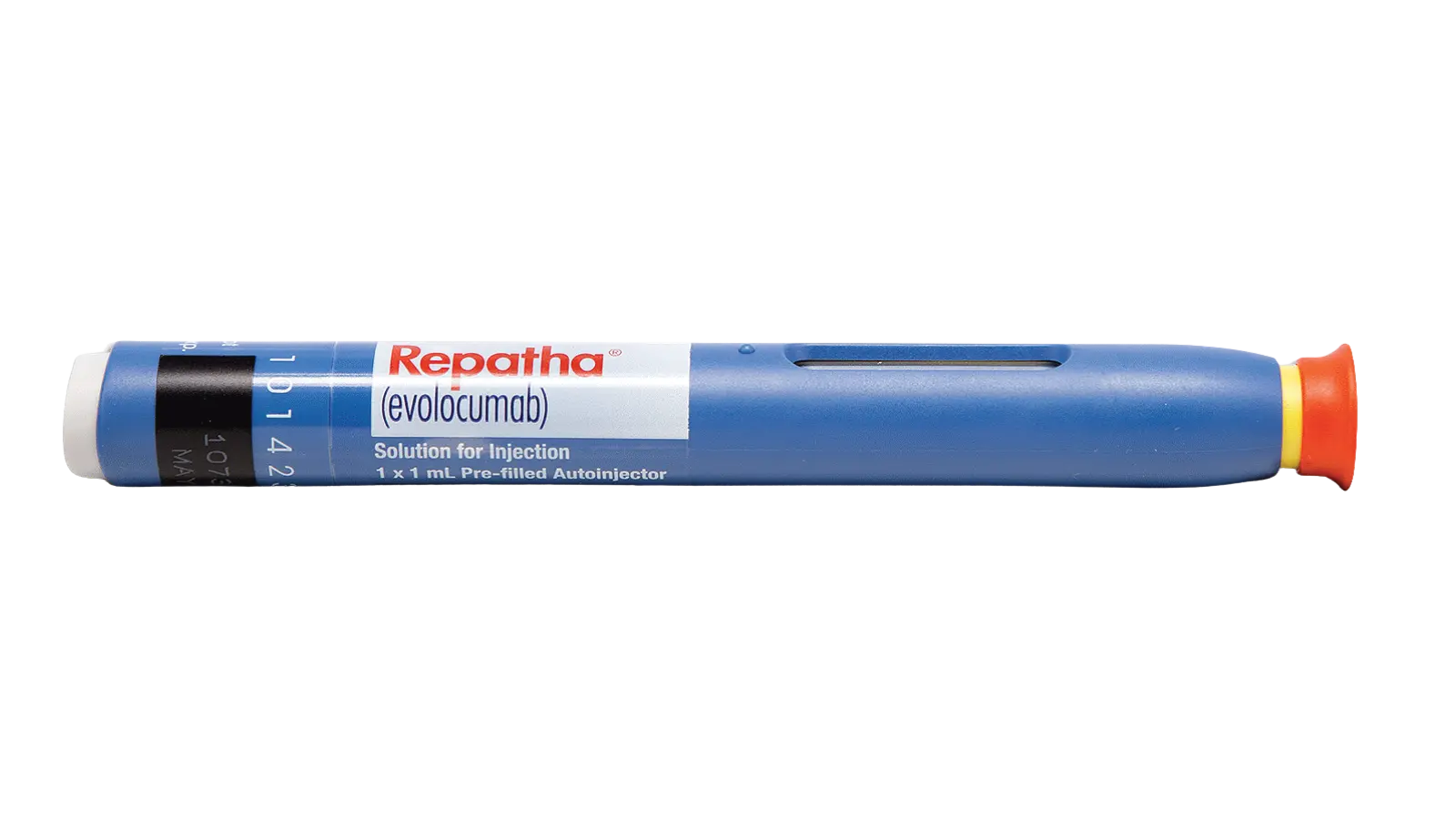
Repatha is a subcutaneous injection. You give it yourself, biweekly or monthly, with a prefilled pen or syringe. So the most distinctive side effect is local: a small patch of skin that hurts, reddens, or bruises after the shot.
In FOURIER's 27,564 patients, injection-site reactions occurred in 2.1% on Repatha versus 1.6% on placebo injections. Pooled phase 2 evolocumab data showed similar rates, with most reactions rated mild. Most weren't severe enough to stop treatment.
Two things to know about local reactions:
- They fade with time. OSLER-1 tracked rates yearly. Year 1: 4.1% annualized. By year 4 onward: 0.2% annualized. Either patients learn injection technique or their immune systems stop reacting.
- Severe hypersensitivity is rare but real. A published case report describes one patient with severe, recurrent reactions to both PCSK9 inhibitors who had to stop. This appears to be uncommon enough to be a case report rather than a registry entry.
The Cognition Question (and Why It Came From a 2015 Signal)
Online forums often mention memory problems on Repatha. That worry traces to one early study: in OSLER (2015), patients on evolocumab reported neurocognitive events slightly more often than the standard-care control group. The signal was unblinded and based on patient self-report, but it was enough to launch a dedicated cognitive trial.
That trial was EBBINGHAUS, a substudy within FOURIER. Researchers ran formal cognitive testing on 1,204 patients for a median of 19 months. Result: no difference in executive function, working memory, episodic memory, or psychomotor speed between Repatha and placebo.
The full FOURIER cohort told the same story. Across 27,564 patients, neurocognitive event rates were similar between Repatha and placebo. In FOURIER-OLE, the long-term extension following patients out to 8.4 years, achieving LDL under 20 mg/dL was not linked to higher rates of neurocognitive events or any other safety outcome.
The same two meta-analyses that found no excess muscle or diabetes events also found no increase in neurocognitive adverse events across more than 110,000 patients. The original OSLER signal appears to have been noise from an unblinded design. Eight years of careful follow-up has not reproduced it.
Prescribed by a licensed physician. Sent to your pharmacy.
The Diabetes Question
Statins modestly raise the risk of new-onset diabetes. Patients reasonably ask whether Repatha does the same.
The answer from the largest dataset: no. In FOURIER, the hazard ratio for new diabetes on Repatha was 1.05 compared to placebo, a non-significant difference. HbA1c and fasting glucose tracked identically over 2.2 years. The same was true in patients with prediabetes (HR 1.00) and in metabolic syndrome.
A safety meta-analysis did flag one nuance: in the first 12-24 weeks, patients with pre-existing diabetes showed a small worsening of glucose control on Repatha. This effect dissipated with longer treatment and didn't translate into excess new diagnoses overall. If you have diabetes and start Repatha, having your HbA1c checked at 3 and 6 months is reasonable.
What Happens Beyond 5 Years
The long-term concern with any newer drug is whether something appears later. FOURIER-OLE followed 6,635 patients for an additional median of 5 years on top of the original trial, with maximum exposure of 8.4 years. The findings:
- No increase in serious adverse events, muscle problems, new diabetes, hemorrhagic stroke, or neurocognitive events
- Achievement of LDL under 20 mg/dL was associated with lower cardiovascular risk and no safety signal
- No cataracts, no excess cancer
- Patients originally randomized to Repatha had a 15% lower risk of cardiovascular death, heart attack, stroke, or hospitalization for unstable angina or coronary revascularization than those who started later
The drug's safety profile after 8+ years looks essentially identical to its safety profile after 2 years.
When to Actually Call Your Doctor
Most Repatha side effects are nuisance-level and resolve on their own. A few situations warrant a phone call:
- A severe, spreading reaction at the injection site (not just redness or a small lump)
- Hives, swelling of the face or throat, or trouble breathing (possible allergic reaction)
- Persistent muscle pain that's clearly different from your baseline
- New-onset confusion or memory issues that family or friends notice (rare, but flag it given your concern)
- If you have diabetes, a meaningful jump in fasting glucose or HbA1c in the first 6 months
How Repatha Compares to What You're Probably Thinking About
If you're researching Repatha, you've likely already tried statins or are considering whether to add Repatha to one. The relative side-effect burden looks like this:
| Drug class | Muscle aches | New diabetes risk | Memory issues | Injection issues |
|---|---|---|---|---|
| Statins | Reported in a meaningful minority | Modest increase reported | Concern raised, largely not confirmed | None (oral) |
| Ezetimibe | Low | None | None | None (oral) |
| Repatha (evolocumab) | Same as placebo | None overall | None confirmed | 2-4%, mild |
The honest comparison: Repatha trades the oral convenience of a statin for an injection, and trades statin-class muscle and metabolic concerns for a small risk of injection-site irritation. If statin tolerance is your problem, Repatha solves it. If statin convenience is your priority, Repatha doesn't.
What This Means If You're Considering or Already Taking Repatha
Patient reviews of Repatha online tend to be polarized: people post when something goes wrong, rarely when nothing happens. The trial and registry data capture both groups and paint a much calmer picture. Most people get a sore arm a few times and otherwise feel nothing, about 1 in 20 stop within the first year because of side effects, and the cognitive and diabetes worries that surfaced in 2015 have not held up under careful study.
If you're considering Repatha, the most useful starting point is a conversation with someone who can evaluate whether the drug fits your specific lipid profile and history. Instalab's Repatha Prescription Review ($99) pairs you with a licensed physician who reviews your labs, prescribes the medication if appropriate, and adjusts the regimen over time as your numbers and tolerance evolve.