
What is Lipfendra (enlicitide), and how does it compare to statins, Repatha, and other cholesterol drugs?
Lipfendra (enlicitide) is the first once-daily oral PCSK9 inhibitor, a pill that lowered LDL cholesterol by about 56 percent beyond a placebo pill in a roughly 2,900-person trial. Its reported list price is about $315 a month, but it has not yet been shown to prevent heart attacks or strokes.


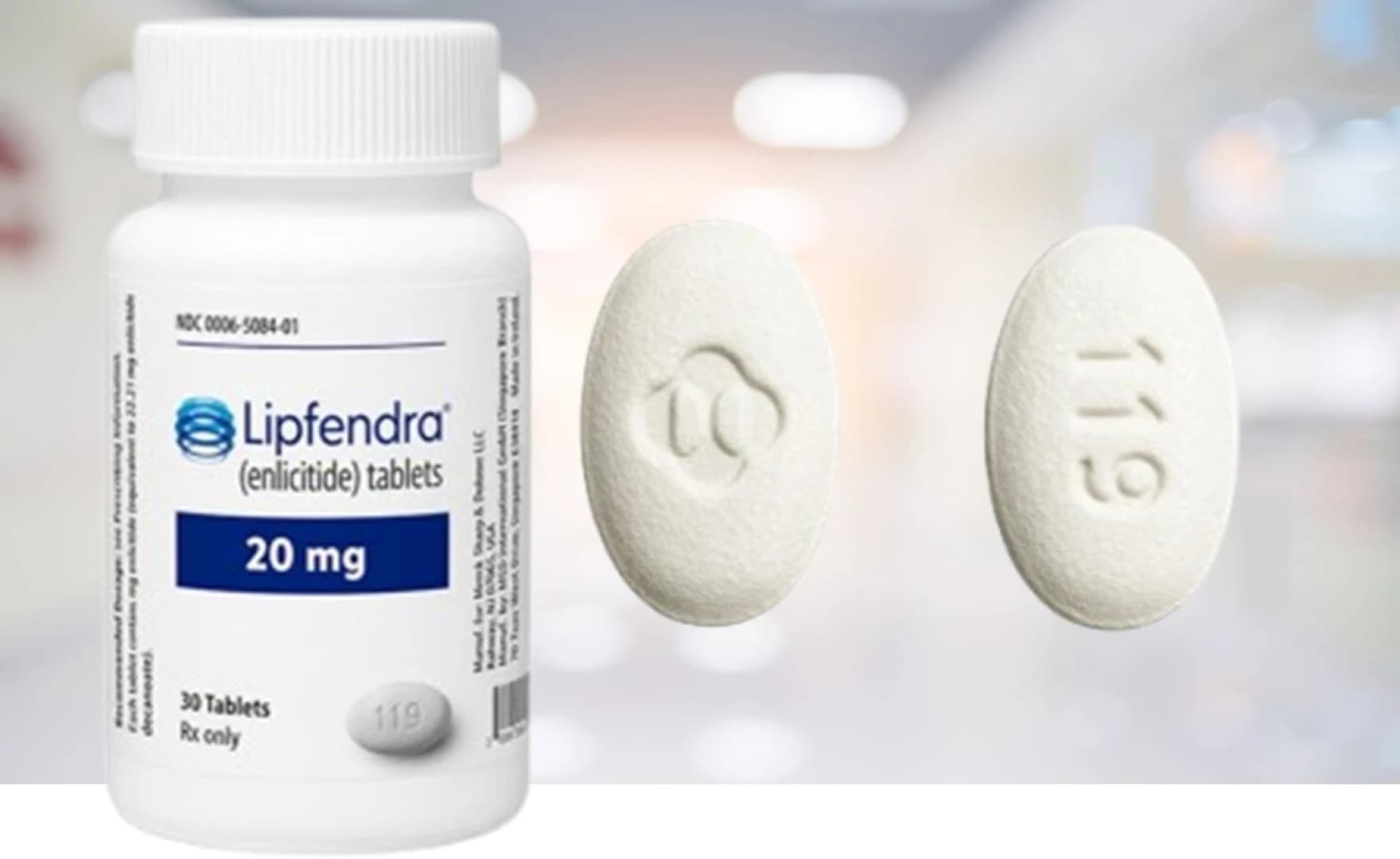
Lipfendra (enlicitide) is a pill that blocks PCSK9, a protein that otherwise keeps LDL cholesterol high. In its pivotal trial it lowered LDL by about 56 percent beyond a placebo pill, put its ApoB and Lp(a) reductions in the same range as injectable PCSK9 drugs, and looked well tolerated. The main open questions are cost and whether those lipid numbers translate into fewer cardiovascular events.
- The FDA approved Lipfendra on July 16, 2026 as the first and only once-daily oral PCSK9 inhibitor. The dose is one 20 mg tablet, taken on an empty stomach.
- How it works: it is a small ring-shaped molecule (a macrocyclic peptide) that blocks PCSK9, a protein the liver uses to break down its own LDL receptors. Blocking it leaves more receptors to clear LDL from the blood.
- Beyond LDL, the pivotal trial also showed about a 50 percentage-point drop in ApoB (a protein marker that reflects how many cholesterol-carrying particles you have) and about a 28 percentage-point drop in Lp(a) (lipoprotein(a), a mostly inherited cardiovascular risk particle), both versus a placebo pill.
- The catch: every published result so far is a lipid number, not fewer heart attacks. The cardiovascular outcomes trial (CORALreef Outcomes) is still running, with completion projected for December 2029.
- Best fit: people at high risk or with inherited high cholesterol who are still above their LDL target on a statin plus ezetimibe, and people who cannot tolerate statins and need a large additional drop without injections.
What it is
Lipfendra (enlicitide) is the first PCSK9 inhibitor you can take as a pill instead of an injection. PCSK9 is a protein the liver makes that destroys its own LDL receptors, the ports that pull LDL out of the blood. Enlicitide is a small ring-shaped molecule (a macrocyclic peptide) that blocks PCSK9, so more receptors survive and clear more LDL. Injectable PCSK9 drugs use the same target; the difference is the format, a daily pill taken on an empty stomach rather than a shot.
It was FDA approved on July 16, 2026 for adults with high cholesterol, including inherited high cholesterol (heterozygous familial hypercholesterolemia). In a head-to-head trial, it lowered LDL more than two common oral non-statin options, ezetimibe and bempedoic acid, when added on top of a statin (these were change-from-baseline comparisons).
How the options compare
| Option | LDL lowering | Route | Cost (US out of pocket) |
|---|---|---|---|
| Enlicitide (Lipfendra) | ~56% (placebo-corrected) | A pill, daily | ~$315/mo reported list |
| Generic statin (rosuvastatin 20 mg) | ~55% (monotherapy, vs baseline) | A pill, daily | ~$4 to $15/mo |
| Ezetimibe | ~18-25% (vs baseline) | A pill, daily | ~$12/mo |
| Evolocumab (Repatha) | ~59% (add-on to statin) | A shot under the skin, every 2 weeks or monthly | ~$239/mo |
| Alirocumab (Praluent) | ~63% (add-on to statin) | A shot under the skin, every 2 weeks or monthly | ~$553/mo |
| Inclisiran (Leqvio) | ~47-51% (placebo-corrected) | A shot by healthcare provider, twice yearly | ~$4,000/dose |
| Bempedoic acid (Nexletol) | ~15-23% (add-on/monotherapy, vs baseline) | A pill, daily | ~$231/mo |
These figures come from separate trials with different designs, not head-to-head tests, so read them as rough context, not a ranking. The one exception is enlicitide, which was tested directly against ezetimibe and bempedoic acid. "Placebo-corrected" means the drop beyond what people on a placebo pill saw. "Add-on to statin" means taken on top of a statin. "Monotherapy" means taken on its own. "Vs baseline" means compared with the person's own starting level. Lipfendra's cost is a reported list price.
In its pivotal trial, enlicitide landed in the same LDL range as the injectable PCSK9 antibodies and well above ezetimibe or bempedoic acid. It also lowered ApoB by about 50 percentage points and Lp(a) by about 28 percentage points versus placebo.
What to weigh
- Outcomes are not proven yet for the pill. Every enlicitide result so far is a lipid number, a stand-in for risk, not proof of fewer heart attacks. Its outcomes trial is still running. The injectable version of this mechanism does have outcome data: in FOURIER, evolocumab cut its main combined endpoint by 15 percent and the secondary endpoint of cardiovascular death, heart attack, or stroke by 20 percent, though it did not reduce cardiovascular death on its own. That is a different drug and does not prove the pill delivers the same benefit.
- Some comparators already have outcome data. Bempedoic acid reduced major cardiovascular events by 13 percent in the CLEAR Outcomes trial, and alirocumab reduced its combined cardiovascular endpoint by a similar margin in ODYSSEY OUTCOMES. These are separate trials in different populations, not a comparison against enlicitide, but they are outcome evidence the pill does not have yet.
- Side effects looked mild. In trials, overall adverse events, serious events, and dropouts were similar to a placebo pill. The main signal above placebo was more diarrhea (about 7 percent versus 2 percent in the inherited-cholesterol trial), and even that difference did not reach statistical significance. Discontinuations were rare.
- Cost and novelty. It is brand new, has only short-term safety data (trials ran up to 52 weeks), and has no generic or pharmacy discount yet, so it is far pricier than generic statins or ezetimibe (see the table).
Who should consider it
- People at high risk, or with inherited high cholesterol, still above their LDL and ApoB targets on the highest statin dose they tolerate plus ezetimibe.
- People who cannot tolerate statins and need a large additional LDL drop.
- People who want injectable-level LDL and ApoB lowering but would rather take a daily pill than a shot.
What is not proven yet
- If you specifically want proven reduction in heart attacks and strokes today, the injectable PCSK9 drugs already have that evidence and this pill does not yet.
- If cost drives your decision, generic statins and ezetimibe deliver a large share of the benefit for a few dollars a month and are worth trying first.
- If you prefer a long real-world safety track record, this drug launched in 2026 and its longer-term data are still accumulating.
- If you are pregnant or planning pregnancy, cholesterol-lowering drugs of this type are generally not used; discuss with your clinician.