 Instalab
CCTA with Cleerly
The most accurate heart health test available. This scan uses high-resolution, AI-enhanced imaging to detect blockages in your heart's arteries before symptoms appear.
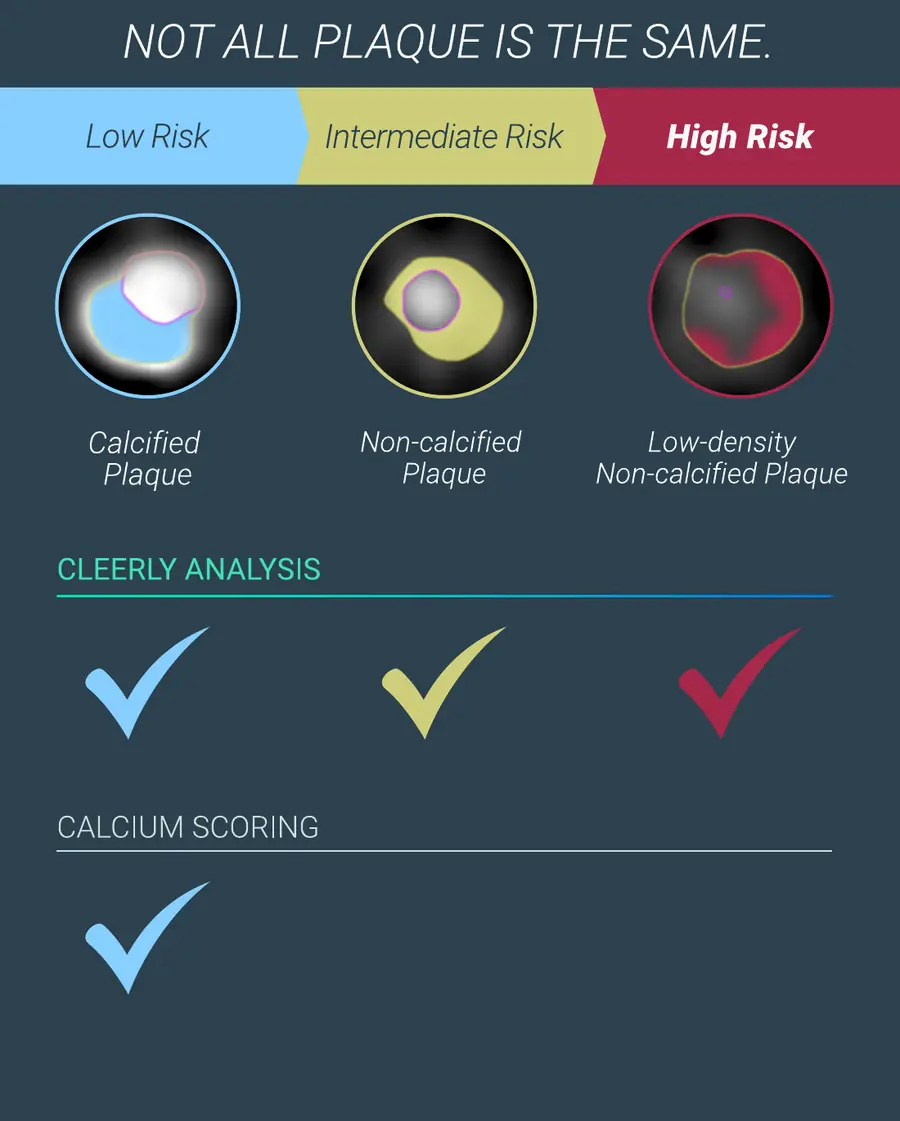
Heart disease is the leading killer in the US, but it's treatable, decades before a heart attack. A coronary CTA gives the full picture, detecting both calcified and non-calcified plaque, which can lead to heart attacks or strokes if ruptured. This is life-saving information.

Dr. Kimberly Brockenbrough
Cardiac Radiologist
How It Works
Step 1: Capture High-Resolution Images of Your Heart with CT Scan
To highlight the plaque in your heart's arteries, a contrast dye is injected into a vein, typically your arm. You may also receive medication to slow your heart rate and improve the clarity of the CT images.

Step 2: Cleerly Plaque Analysis
After your scan, Cleerly's advanced AI software reconstructs a detailed 3D view of your coronary arteries. The software analyzes these images to accurately identify the presence, amount, and type of plaque buildup, as well as areas of artery narrowing.
Step 3: Review Results and Get Your Action Plan
Instalab will highlight your key findings and explain what they mean for your long-term health. You’ll receive a personalized action plan tailored to your goals.

Calcium score or CCTA?
A calcium score counts hardened plaque and nothing else. A coronary CT angiogram shows the arteries themselves, and Cleerly measures what it shows, including the soft plaque behind most heart attacks.
| Test | Calcium score | CCTA with Cleerly |
|---|---|---|
| What it looks at | Hardened (calcified) plaque only, as a score | Every plaque in every coronary artery: how much, what kind and where |
| Soft plaque, the kind most likely to rupture | Not seen. A score of zero does not rule it out | Measured, by type and volume |
| Narrowing | Not measured | Every artery segment, graded minimal to severe |
| Change over time | Calcium only | Plaque by plaque, scan to scan |
| What it involves | A quick CT, no contrast dye | A CT with contrast dye; about an hour at the imaging center |
- A calcium score of zero does not exclude high-risk plaque: a CCTA finds plaque in 41 to 53% of people whose score is zero, and 31% of major cardiac events occur in people whose score was zero.
Figures cited by Cleerly: Swedish CArdioPulmonary BioImage Study (J Intern Med 2015); Western Denmark Heart Registry (J Am Coll Cardiol 2018).
Pricing
We'll help you find the most convenient and affordable testing location near you and handle the appointment scheduling. Enter your location below to search our database.
Your Address
Already Had a CCTA?
Get the Cleerly plaque analysis on a coronary CT angiogram you've already had, without repeating the scan. It needs the scan's DICOM images as a download and a scan done on a 64-slice or newer CT scanner, which the imaging center can confirm.
FAQ