2-minute questionnaire
Answer questions about your history, prior cholesterol treatments, and cardiovascular goals. No appointment needed.
 Instalab
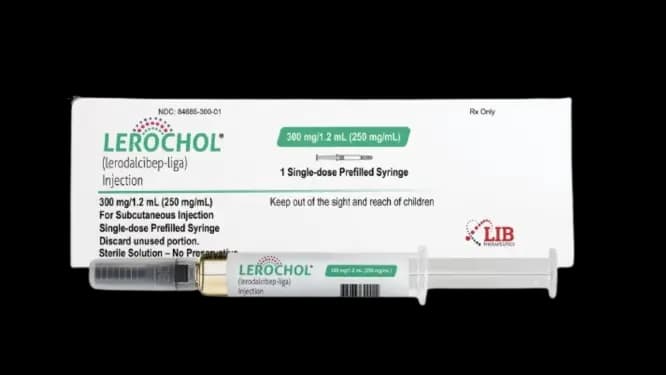
Lerochol (lerodalcibep) is a once-monthly PCSK9 inhibitor that cuts LDL by about 60%, with the same target as Repatha on half the injections. Prescription, refills, and physician follow-up included.
No appointments. No clinic visits. A licensed physician reviews your case, checks what you'll pay, and, if appropriate, sends the prescription to your pharmacy.
Answer questions about your history, prior cholesterol treatments, and cardiovascular goals. No appointment needed.
A licensed physician evaluates your eligibility, usually within 1 business day, and reaches out if they need anything else.
Lerochol is newly launched, so coverage is still rolling out plan by plan. We check your insurance and file prior authorization if your plan covers it. If it doesn't, LIB Therapeutics' direct-to-patient program sets a flat $199 per month, no insurance needed.
Your prescription goes to your preferred pharmacy. We'll walk you through the first injection and check in after your first dose.
Two line items: Instalab+ and the Lerochol medication itself. No hidden fees.
Physician oversight and ongoing follow-up
Lerodalcibep prefilled syringe, one per month, billed by pharmacy
Why pay a monthly fee? Lerochol is brand new, and getting it covered takes a physician who knows the drug and the paperwork. Instalab+ covers the visits, prescription renewals, prior authorization, and enrollment in LIB's direct-to-patient program if your plan says no. We also recommend a lab recheck around 6 to 8 weeks and follow up on your results, though lab costs are billed separately.
Lerochol launched in the United States in mid-2026, so formulary decisions are still rolling out and LIB expects coverage to expand through 2027. Plans that add it are expected to use the same criteria as the other PCSK9 inhibitors: familial hypercholesterolemia, established cardiovascular disease, or documented statin intolerance, usually after a documented statin trial. We check your plan and file the prior authorization either way. If your plan doesn't cover it yet, LIB Therapeutics' direct-to-patient program sets a flat $199 per month cash price, less than the assisted cash price of the other injectable PCSK9 inhibitors.
A brand-new drug needs a physician who knows it, paperwork handled, and labs to confirm it's doing its job. Here's how our team handles that for you.
A licensed physician reviews your history and labs, confirms Lerochol is right for you, and writes the prescription. In parallel, we verify your insurance coverage, file prior authorization, and set up LIB's $199 direct-to-patient price if your plan won't cover it. If you'd rather pay cash from the start, this takes as little as one day.
Your syringe can be picked up at or delivered by your preferred pharmacy. Let it sit at room temperature for 30 minutes, then inject under the skin of your thigh or stomach. We can walk you through the first one and check in the next day.
LDL is at its new level by 4 weeks. We recommend rechecking LDL and ApoB at a lab near you, and your physician reviews the results with you. Labs are billed separately. Rechecking is optional, but most patients want to see their numbers move.
Your physician tracks your labs over time and adjusts the plan as your numbers evolve. We keep your prescription, prior authorization, and direct-to-patient enrollment active, so you don't lose progress to paperwork.
Schedule a PCP visit. Wait months. Hope they've heard of a drug launched this year. Fight the prior authorization yourself. Book and chase your own labs.
2-minute questionnaire. Physician review within 1 business day. Insurance and cash pricing handled. Lab reminders built in.
Lerochol comes in a single-dose prefilled syringe: 1.2 mL under the skin of your thigh or stomach, once a month. It keeps at room temperature for up to 3 months, so it travels without a cooler.
Statins slow cholesterol production in the liver. PCSK9 inhibitors take a different path: they block the protein that destroys LDL receptors, so your liver keeps clearing LDL from your blood. Repatha and Praluent do this with an antibody injected every two weeks. Lerochol does it with a smaller engineered protein, fused to albumin so one injection lasts a month.
The Phase 3 LIBerate program enrolled more than 2,900 adults in placebo-controlled trials of up to 52 weeks. LIBerate-HR (JAMA Cardiology, 2024) randomized 922 adults with or at high risk of cardiovascular disease and cut LDL by 56% at one year, with 94% reaching at least a 50% reduction. LIBerate-HeFH (European Heart Journal, 2023) randomized 478 adults with familial hypercholesterolemia and cut LDL by 59% at 24 weeks. Side effects were similar to placebo apart from injection-site reactions. FDA approval followed in December 2025. The label was updated in August 2026 to note that outcomes trials of statins and antibody PCSK9 inhibitors have shown that lowering LDL this way reduces heart attacks and strokes in adults at increased risk; Lerochol has not yet reported an outcomes trial of its own.
Lerochol is a prescription medicine. Important safety information applies. The most common side effects are injection-site reactions, cold-like symptoms, diarrhea, nausea, and swelling of the legs or ankles. Serious side effects are uncommon.
Common Questions
Answer a few questions about your history and goals. A physician reviews your case and, if appropriate, prescribes Lerochol.
No commitment to treatment.